


Hello Marathoners-
I've just returned from Mallorca, Spain, where I had the joy of celebrating the wedding of Jeffrey and David. They are two of the most fun and loyal friends I have, and a big part of the reason I spend more of my time in New York City these days. It was an honor to celebrate with them in such a beautiful place. Every single detail was meticulously planned and flawlessly executed, the weather was perfect, and (as the photos below will attest) a great many rugs were cut. Coincidentally, their professional profiles happen to bear a striking resemblance to our typical client household: Jeffrey is a breast radiologist at Memorial Sloan Kettering, and David is a facial plastic surgeon at Cornell specializing in rhinoplasty.


Celebrating Jeffrey and David in Mallorca
Speaking of remarkable physicians, this month's client spotlight is a special one.
The Woman Who Changed What We Know About CTE
I'm continuing my occasional client spotlight series with someone whose work you have almost certainly encountered, whether you realize it or not. If you've watched a football game, followed the debate around concussions and youth sports, or heard the letters “CTE” sometime over the past 15 years, today's client has played an enormous role in shaping what we know about it.
Meet Dr. Ann McKee.

Dr. Ann McKee
Ann is a neurologist and neuropathologist at Boston University and the VA Boston Healthcare System, and quite simply, she is one of the world's leading authorities on chronic traumatic encephalopathy, or CTE. She serves as the William Fairfield Warren Distinguished Professor of Neurology and Pathology at BU—the University's highest faculty distinction—and directs both BU's CTE Center and Alzheimer's Disease Research Center. She also leads the UNITE Brain Bank, the world's largest repository devoted to the study of traumatic brain injury and CTE.
The work behind those titles is the real story.
When Ann began studying the brains of former athletes, our understanding of the long-term consequences of repetitive head trauma was remarkably limited. Her research helped establish that it isn't only diagnosed concussions that matter: years of repetitive, seemingly “minor” impacts can produce a progressive neurodegenerative disease. Ann and her team went on to define the hallmark pathology of CTE and develop the criteria used to diagnose and stage the disease. Her research has examined thousands of brains from athletes, military veterans, and others exposed to repetitive head trauma and has helped move CTE from a poorly understood condition into a major area of neuroscience and public-health research.
Along the way, Ann has been responsible for a remarkable list of firsts. She reported the first cases of CTE in athletes from ice hockey, soccer, mixed martial arts, baseball, high school football, and college football, as well as the association between CTE and ALS. Her team identified CTE in a 17-year-old athlete—the youngest case ever reported—and more recently published the largest study of CTE in young athletes to date. Among 152 brain donors who had participated in contact sports and died before age 30, 63 showed evidence of CTE. More than 70% of those diagnosed had never played professionally.
The implications extend well beyond professional sports. Ann's work now encompasses military veterans exposed to blast injuries, amateur and youth athletes, and others subjected to repetitive head trauma. Her lab is using everything from single-nucleus RNA sequencing and spatial transcriptomics to advanced 3D imaging to understand what is actually happening inside the brain as the disease develops. The ultimate goal is a big one: understand the disease well enough that we can eventually diagnose, treat, and, most importantly, prevent it.
Recognition has followed. Ann was elected to the National Academy of Medicine in 2018, the same year TIME named her one of the 100 Most Influential People in the World. She has received the Henry Wisniewski Lifetime Achievement Award in Alzheimer's Disease Research and the Samuel J. Heyman Service to America Career Achievement Medal, and she was named the Boston Globe's Bostonian of the Year. Earlier this year, Boston University selected Ann to deliver its 2026 University Lecture, an honor reserved for faculty members whose research and scholarship have made an extraordinary contribution to their field.
What I find most remarkable about Ann's story, though, is that the science forced people to rethink assumptions that had been around for generations. Her findings have influenced conversations among physicians, parents, athletes, coaches, sports leagues, and the military about what repeated blows to the head can mean decades later. That's a pretty extraordinary legacy for research that began with Ann looking through a microscope and asking questions that, at the time, very few people were asking.
We're incredibly fortunate to have Ann as part of the Marathon family, and I'm very happy to have an excuse to brag about her a little bit.
Ann built a career on questioning assumptions that had gone unchallenged for generations. In a far humbler way, that's our job too.
Morningstar publishes a monthly chart pack called Signal & Noise, and its premise describes what we do about as well as anything I could write. Every month brings a fresh wave of market and economic data. Some of it matters, and some of it is pure noise. The work is telling the two apart, and the best tool I know for that is to hold whatever is happening right now up against the long sweep of history.
This fall, three pieces of noise are getting far more airtime than they deserve: the midterm elections, the question of whether AI is a bubble, and the selloff in the bond market. Let me take them one at a time, and then tell you why none of them changes what we do.
The Midterm Noise
The midterms are Tuesday, November 3. If history is any guide (and it's the only guide we have), the next few weeks will bring no shortage of commentary on what a shift in control of the House or Senate means for your portfolio.
So let me offer one number to hold onto: 342 million.
That's roughly how many people live in the United States. The Census Bureau estimated 342,620,143 as of July 1. Every day, those people go to work, start businesses, hire, invent things, pay mortgages, buy groceries and, yes, invest. Their collective effort drives the U.S. economy, and over time, the earnings of American businesses follow it.
Not one person in the Oval Office and 535 on Capitol Hill.
Policy matters at the margins, of course. But Washington doesn't do the work. The people do.
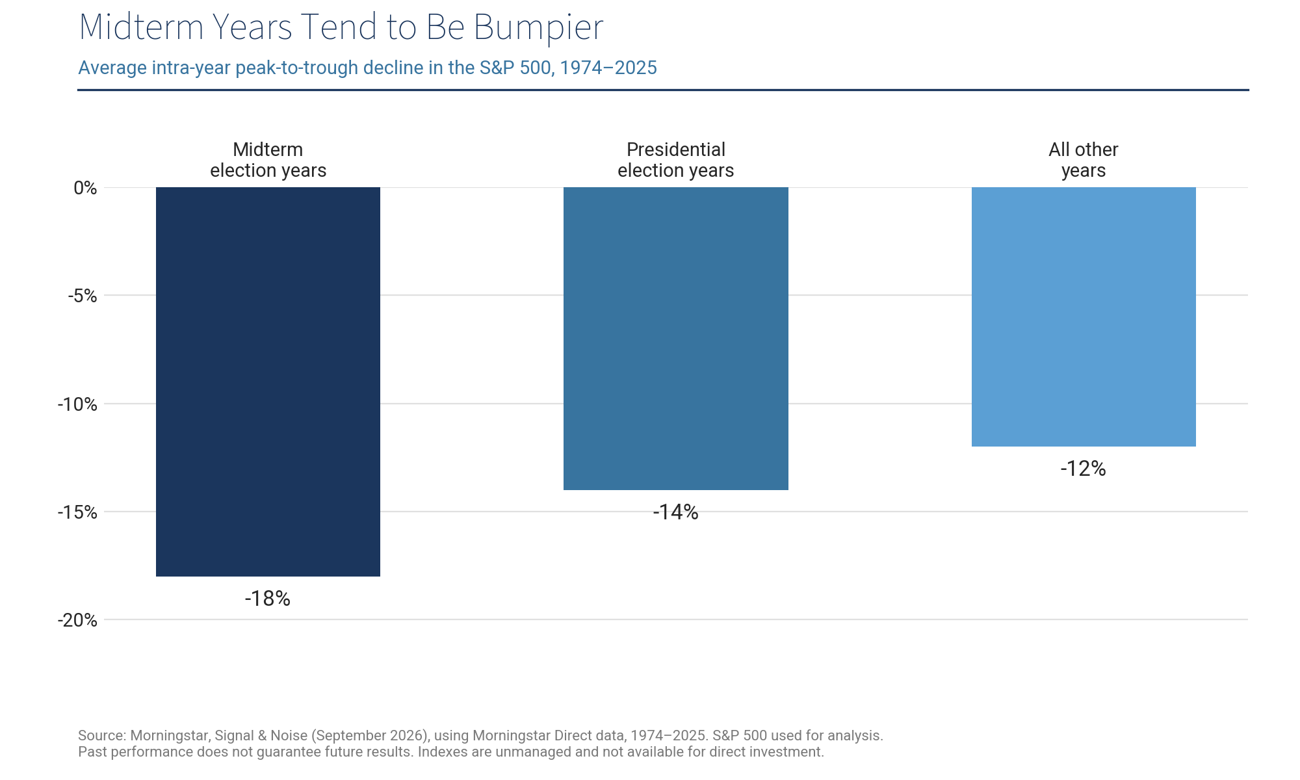
The historical record backs this up. Midterm years have a reputation for being bumpy, and they've earned it. Since 1974, according to Morningstar, the S&P 500's average peak-to-trough decline within a midterm year has been 18%, against 14% in presidential election years and 12% in all other years. Clearnomics finds that since 1933, the S&P 500 has averaged an 8.6% total return in midterm years, compared with 15.9% in years with no election at all.
And then? Since 1950 there have been 19 midterm elections, and the S&P 500 was higher 12 months later after every one of them, with average gains in the mid-teens depending on how you measure. That stretch included the Korean War, the 1973 oil shock, several recessions, and every possible combination of who controlled what.
Do I think that streak proves anything about this November? I do not. Nineteen elections make a small sample, and history is suggestive rather than predictive. What it does suggest, in this one man's opinion, is that what happens on November 3 will matter far less to your long-term results than the headlines will claim.
We are goal-focused, plan-driven, long-term investors. Your portfolio is built around your plan, and your plan doesn't change based on which party holds the gavel.
The Bubble Everyone Is Waiting For
The second piece of noise is one I suspect will be with us for years: is AI a bubble?
Ruben Hassid, who writes a widely read newsletter called How to AI, recently made a point that stuck with me. The instinct goes something like this: everything is moving so fast, faster than feels reasonable, so surely it has to be a bubble.
His answer is that the world was speeding up long before AI arrived. For most of human history, someone born 250 years after an ancestor would have recognized nearly everything about that ancestor's daily life: the work, the tools, the food, the pace. Today, 25 years is enough to make the world feel unrecognizable. (Think back to 2001. No iPhone, no streaming, and if you were lucky, a flip phone.)
I wanted to see that acceleration for myself, so here is world GDP over the last 2,000 years.
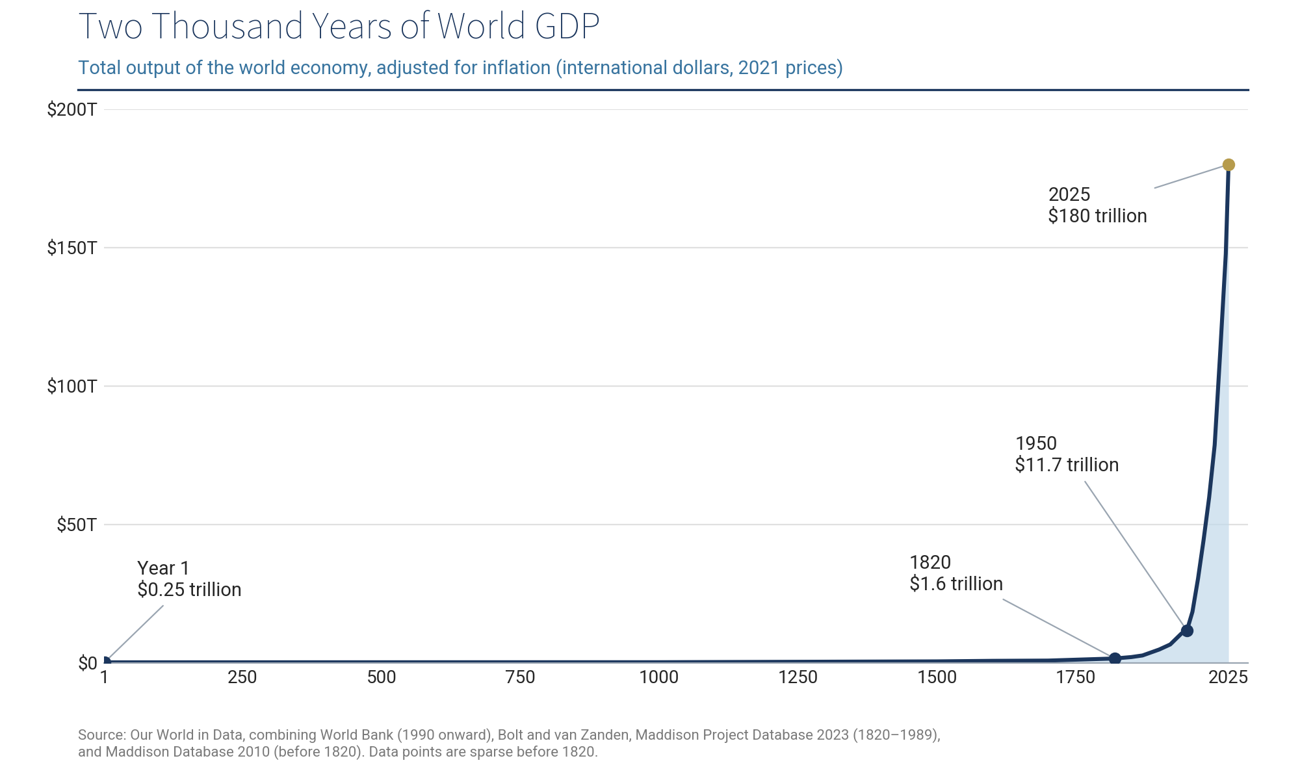
For roughly 1,800 years, global output barely moved, growing about six and a half times between year 1 and 1820. In the two centuries since, it has grown about 110-fold, to roughly $180 trillion in 2025. And in just the last 25 years, the world added about $100 trillion of annual output, more than the entire world economy produced in 1990. The world has been accelerating for 200 years, and it shows no sign of stopping.
Numbers like that can feel abstract, so let me share a lovely little website I came across recently, Ordinary Abundance, built by Jordan Dworkin. It walks you through an ordinary modern apartment one object at a time, alongside the words of the people who first marveled at each one. In 1888, the novelist Edward Bellamy imagined that music on demand, at home, would be “the limit of human felicity.” Today it plays from a speaker most of us barely notice. In medieval price lists, a pound of ginger sold for about the price of a sheep. Before the sewing machine, a single new shirt meant some fourteen hours of hand stitching. And in eighteenth-century Britain, a pineapple was costly enough that hostesses sometimes rented one for the evening rather than eat it. (I can't decide whether that's the most or the least sensible thing I've ever heard.)
Dworkin's point, which I love, is that it's to our credit that we stay restless in the middle of all this progress, always pushing for the next treatment or the next tool. But it's worth recapturing, every so often, a little of the old sense of awe at wonders that have long since become commonplace. Some of what feels like hype today may one day sit quietly on that list.
Ruben also points out that today's bubble talk sounds an awful lot like the early 2000s, and the dot-com era does cast a long shadow. Plenty of investors have spent the better part of a career bracing for the next one. The trouble is that calling a bubble only helps if you also get the timing right. Call it early and you simply miss the growth you were worried about. Ruben illustrates the point with a cartoon of apes confidently assuring one another that New York City is a bubble, which made me laugh and wince at the same time. (He goes further, calling the belief that AI is a bubble “the most dangerous belief you can hold in 2026.” I'd put it more gently, but I take his point.)
Four Lenses
Ruben looks at the question through four lenses, which I find a useful way to cut through the noise. I've paired each with data from Stanford's annual AI Index, which I trust more than anyone's hot take, including my own.
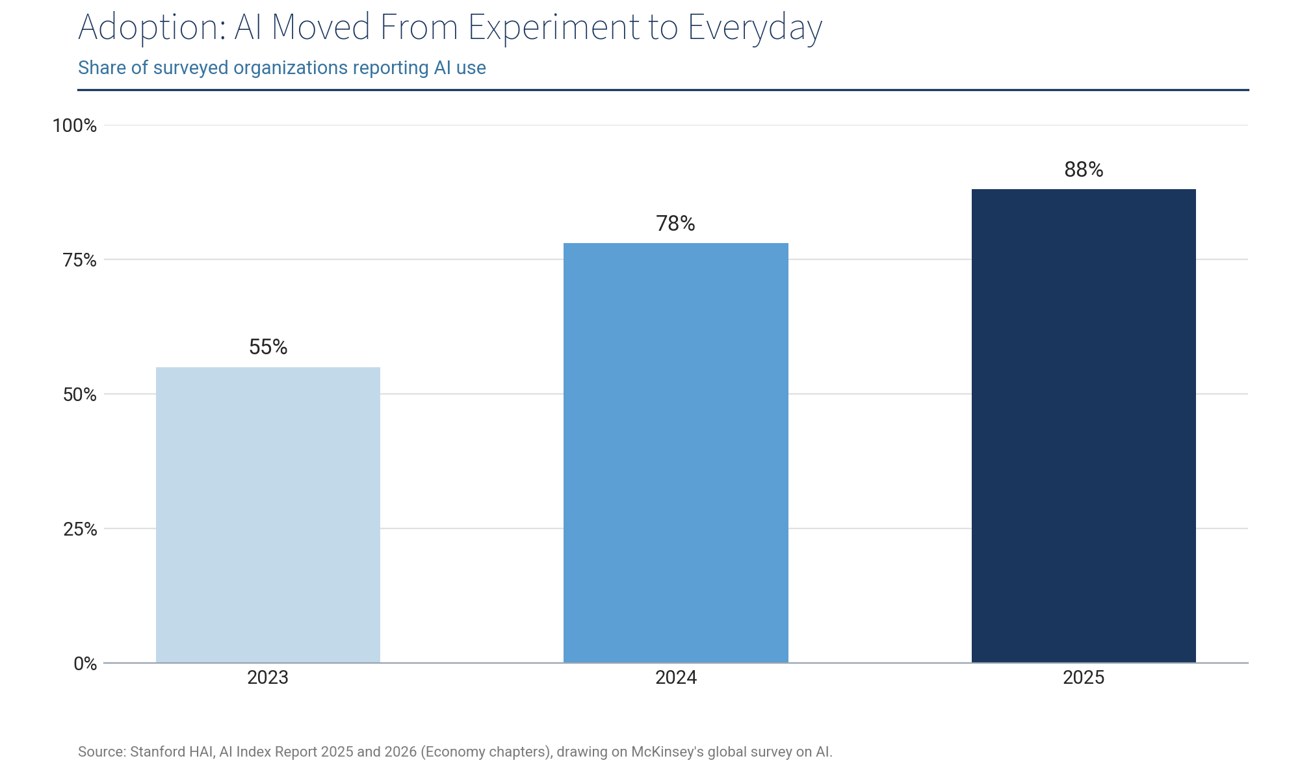
Adoption: are more people using AI, more often? Stanford reports that 88% of surveyed organizations used AI in 2025, up from 78% in 2024 and 55% in 2023. Generative AI reached 53% of the population within three years, faster than either the personal computer or the internet.
Monetization: are people spending more on AI? Global corporate investment in AI more than doubled in 2025, to a record $581.69 billion. That's more than half a trillion dollars in a single year.
Intelligence: is AI becoming more capable? Yes, though unevenly. Stanford calls it a “jagged frontier”: models that excel at hard tasks can still struggle with simple ones, such as reading an analog clock. (I find that oddly comforting.)
Affordability: is the same capability getting cheaper? This is where the numbers get startling. Per Stanford's 2025 AI Index, the cost of running a model at the level of GPT-3.5, the engine behind the original ChatGPT, fell from $20.00 per million tokens in November 2022 to 7 cents by October 2024. That's a 280-fold decline in less than two years (not a typo). A “token” is roughly a fragment of a word, so think of it as the price of a fixed amount of AI output.
Bubbles tend to form when prices soar while the underlying usage and economics lag behind. On these measures, usage, capability and affordability are all moving in the right direction, and quickly.
What the Price Tag Says
None of this would matter much if investors were simply paying any price to own the future. So it's worth asking what the market actually costs today.
Over the long run, stock prices follow earnings. Since 1950, the S&P 500's price and its earnings have moved together with a correlation of 97%. (That's about as close as anything in finance gets.) It's the reason I keep insisting that we are investors in businesses: what those businesses earn is what eventually shows up in the price.
Last month we marked the 25th anniversary of September 11. When the market reopened the following Monday, it fell five days straight, closing at 966 on Friday, September 21, 2001. That was in the middle of a 929-day, 49% decline that began with the bursting of the dot-com bubble and ended with the accounting scandals of 2002. In mid-September, the S&P 500 stood around 7,600, just shy of eight times that level, despite a whole new set of worries: rising inflation, rising interest rates, wars with no end in sight, and a $40 trillion national debt. Why? Because earnings are up close to nine times over the same stretch. In the long run, earnings drive stock prices far more than macroeconomics, politics or geopolitics ever will.
And earnings have been growing remarkably fast. Trailing 12-month earnings for the S&P 500 recently grew 30.1%, against a historical average of 7.9%. In the first two quarters of 2026, the seven largest technology-related companies grew their earnings 63% and 119% from a year earlier. More telling, to me, is what the other 493 companies in the S&P 500 did: 18% and 32%. The growth runs well beyond a handful of famous names.
When earnings rise that fast, prices can climb a long way without the market becoming more expensive. As of September 1, the S&P 500 traded at 20.2 times its expected earnings over the next twelve months. That's close to its 10-year average of 19.8, and a bit below its 5-year average of 20.7.
The comparison to 1999 is instructive too. In March 2000, four of the market's largest companies traded at an average of 97 times expected earnings. Four of today's largest average about 26. Think about that for a moment.
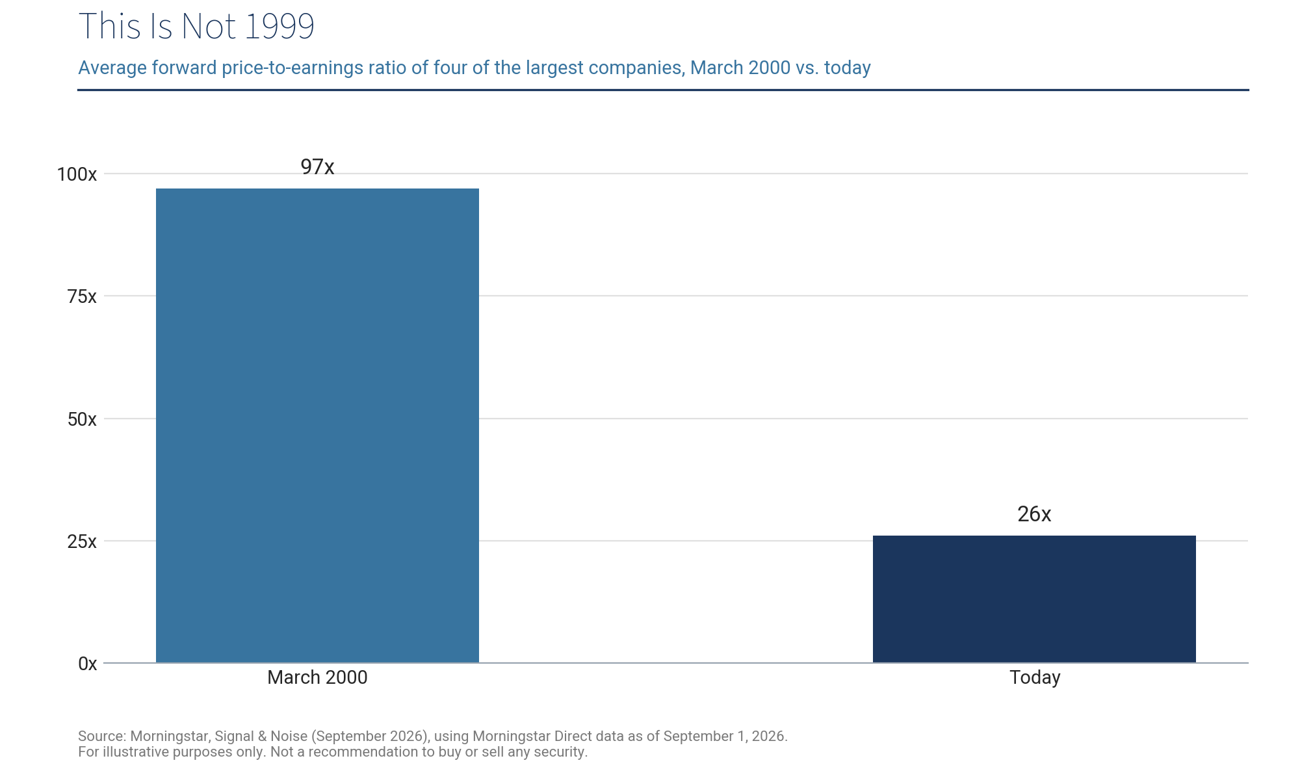
Forward earnings are analysts' estimates, of course, and estimates can be wrong. But in this one man's opinion, a market priced near its 10-year average on rapidly rising earnings doesn't look like the bubble so many headlines describe.
Where It Could Go Wrong
That said, none of this makes the AI boom risk-free, and I'd be doing you a disservice if I pretended otherwise.
A transformative technology and a profitable investment are two different things. The railroads remade 19th-century economies, and plenty of railroad investors were wiped out. The internet changed everything it touched, and many of the dot-com darlings of 1999 no longer exist. AI could follow the same path, with the technology succeeding while many of the companies betting on it fail.
The spending is running well ahead of the payoff. Half a trillion dollars in a single year is precisely the kind of number that should make any thoughtful investor a little uneasy. And while adoption is wide, Stanford notes that the use of AI agents remains early, which suggests the deeper, more profitable uses are still mostly ahead of us. If the returns take longer to arrive than investors expect, some of today's valuations could prove too optimistic.
Concentration is real, though it may be loosening. The ten largest companies still make up 38% of the U.S. market's value (surprisingly, among the lowest of any major country). But the largest technology companies have lost their grip on leadership. Since January 2025, most of them have trailed the S&P 500, and as a group they were up just 3.4% this year through September 1, against 12.3% for the index. Several have also gotten cheaper, trading below their average valuations since the bull market began in late 2022.
Some valuation measures do flash yellow. The Shiller CAPE ratio, which compares prices to the past ten years of inflation-adjusted earnings, stands at 40.6, nearly double its long-run average of 22.0. Part of that gap may reflect how quickly earnings have grown lately, since a ten-year average is slow to catch up. Even so, 38% of the companies in the S&P 500 trade above ten times their annual sales, which leaves little room for disappointment.
And the financing deserves watching. As we discussed in September, some of the buildout is being funded with debt, and there are fair questions about how quickly the hardware loses its value.
Any of these could produce a sharp, painful decline in AI-related stocks. I'd be surprised if we didn't see at least one along the way.
The Bond Selloff
The third piece of noise is newer, and the headlines around it have been especially loud: the selloff in the bond market.
The numbers are real. Bond prices move inversely with yields, and with yields climbing, every major Morningstar bond index lost money in the third quarter. The broad U.S. core bond index fell 3.44%, and long-term Treasurys fell 8.01%. The 10-year Treasury yield touched 5.29% in late September, up from about 4.3% six months earlier, and the 30-year reached 5.64%. In September, the Fed raised rates by a quarter point, its first hike in three years.
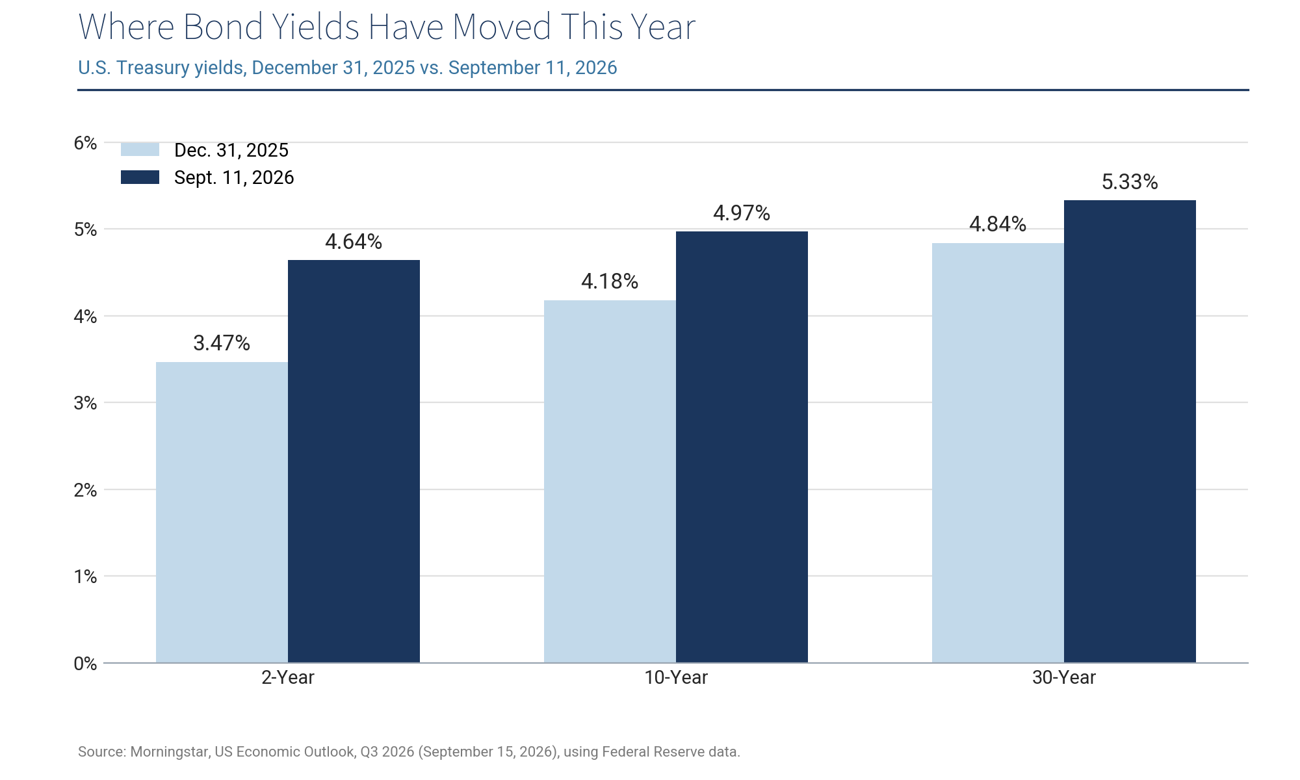
It would be completely natural to read all of this as a sign that something is breaking, most likely that the market has finally lost patience with Washington's borrowing. Two of the most thoughtful pieces I've read this fall argue otherwise.
Kana Norimoto, who leads Fidelity's Asset Allocation Research Team, writes that rising Treasury yields do not necessarily signal an impending crisis. In her view the picture is less sensational and more mechanical: yields are adjusting so that the supply of bonds meets investor demand. She points to a mix of forces, including stronger growth expectations, stubborn inflation, heavy government borrowing, and a new wave of corporate borrowing to fund the AI buildout. The era of easy money is over, as she puts it, and markets are working out what capital ought to cost now.
Preston Caldwell, Morningstar's chief U.S. economist, reaches a similar conclusion from a different direction. He finds that this year's rise in yields has more to do with the market's improving view of the economy and the labor market than with worries about the government's finances. Nearly all of the increase has come from real (inflation-adjusted) yields, while the inflation expectations built into bond prices have barely moved since 2025. And the increase has been led by short-term yields, which track expectations for Fed policy.
Meanwhile, the economy still has access to credit. In the Fed's latest survey of bank loan officers, larger banks held their lending standards for businesses steady while smaller banks eased them, demand for loans rose from companies of all sizes, and banks have been narrowing the spreads they charge. As LPL Research noted, how willing banks are to lend can matter as much as where interest rates sit. Housing is the clear exception: mortgage rates climbed back above 7% in September, and many homeowners holding cheap loans simply aren't selling.
Where rates go from here is anyone's guess, and the experts disagree. Caldwell expects the Fed to cut rates twice in 2027 and four times in 2028, with the 10-year yield falling to 3.5% by 2029. Norimoto expects that elevated rates and rate volatility may remain a feature of the landscape for some time. (A perfect illustration of signal and noise: two first-rate economists, the same data, different conclusions.)
The risk Norimoto flags, and the one I'd keep an eye on, is that higher bond yields start competing more directly with stocks for investors' money. That's a reasonable thing to watch, and it's exactly the kind of question your plan is built to absorb.
Why We Don't Need to Make the Call
Which brings me to the part I hope lets you sleep well.
Advisors spend their entire professional lives helping people resist the urge to go crashing out of their investments, or to sit forever in cash, because of some looming crisis, real or imagined. I've come to call it the apocalypse du jour. “Oil prices are rising, interest rates are rising, inflation is rising, wars are endless: we have to get out of the market.”
The misperception hiding inside that very human impulse is the assumption that the value of your investments is governed by whatever financial, economic, political or geopolitical drama happens to be in the news. We are investors in businesses, and the companies you own are working through and around the apocalypse du jour, as they always have.
Which leaves a binary choice. You can act continuously on a plan, one that assumes the stock market will decline an average of 30% or so about every five years, or you can react to the crisis of the moment, liquidate your long-term investments, and watch your most cherished financial goals go a-glimmering. The two policies are mutually exclusive.
There's a good reason the two can't be mixed. The market's best days have a way of arriving right on the heels of its worst, precisely when the urge to get out is strongest. Since 2016, according to Morningstar, eight of the ten best days for U.S. stocks came within a week of one of the ten worst. And the price of missing them is steep. J.P. Morgan research found that an investor who put $10,000 into the S&P 500 in 2005 and simply stayed put through 2024 ended up with more than twice as much as one who missed just the ten best days along the way. Ten days, out of roughly 5,000.
The ultimate test case is making the rounds right now: the fear that AI could wipe out humanity. Now there's a crisis that really sits up and barks! And in the next breath one sees how absurd it would be to let it take anyone off plan. If that ever happened (and it's not at all clear to me how it would), your asset allocation wouldn't have made any difference, would it? And if it doesn't happen, you'll have the same long-term needs and goals you have now, with that much less time to reach them.
So the question to ask is always the same. Interest rates are rising: in what way would significantly changing my portfolio make me more likely to reach my lifetime goals? Inflation is running hot (September’s consumer prices rose 0.6% in a single month, and the S&P 500 fell just over 1% the day the report landed): same question. The midterms are coming: same question. AI might be a bubble: same question. Changing your portfolio in anticipation of, or in reaction to, a “crisis” won't solve life's essential financial challenges, and it may well reduce the odds of ever meeting them. That, in a sentence, is The Big Mistake.
Elections, bubble talk and bond selloffs will all make plenty of noise this fall. The signal hasn't changed: the critical issues remain how much you invest and for how long. Everything else is commentary.
Articles:
Why Social Security's finances are widely misunderstood
15 leaders on the economic indicators companies should watch
Why beneficiary designations usually override wills for retirement and insurance accounts
Your retirement savings could be vulnerable to scams. Here's how to protect yourself
4 reasons to think US inflation will come back down
Ed Slott: Don't waste your low-tax years in retirement
Early retirees: Why now is the time to convert your IRA to Roth
How much of your portfolio should be 'mad money'?
7 investments to keep out of your taxable account
The real story behind the bond market selloff
Doing these 3 'wrong' things with your money? I'm not worried
Retirement planning for parents raising a child with a disability
What if this turns out to be a terrible time to retire?
Are stocks expensive? This 30-year low stat says otherwise
Don't make this mistake when chasing higher bond yields (podcast)
Thanks, as always, for your trust and confidence.
Have a great weekend.
-Charlie
This newsletter is provided for informational and educational purposes only and is not intended to constitute personalized investment advice or a recommendation to buy, sell, or hold any security or adopt any investment strategy. Certain statements reflect the author's opinions, interpretations, and market observations as of the publication date and should not be construed as statements of fact, guarantees of future performance, or predictions of future market events. Such views are subject to change without notice. References to market performance, economic conditions, or historical events are provided for illustrative purposes only. Past performance is not indicative of future results, and historical trends are not guarantees of future market performance. All investing involves risk, including the possible loss of principal. Investment decisions should be made based on an individual's financial circumstances, investment objectives, risk tolerance, and time horizon.