


Key Takeaways
- Stocks finished little changed despite a volatile week. Rising oil prices and yields offset strength in semiconductors and a broad midweek rebound.
- A stronger-than-expected employment report revived concerns about another Fed rate hike, pushing Treasury yields higher.
- Technology remained divided. Semiconductor stocks outperformed, while software companies faced significant pressure following earnings.
- Oil surged roughly 10% amid renewed U.S.-Iran tensions, supporting energy stocks but creating additional inflation concerns.
- Inflation will be the market's primary focus this week. The August CPI and PPI reports will play an important role in shaping expectations for the Fed's September meeting.
Chart of the Week
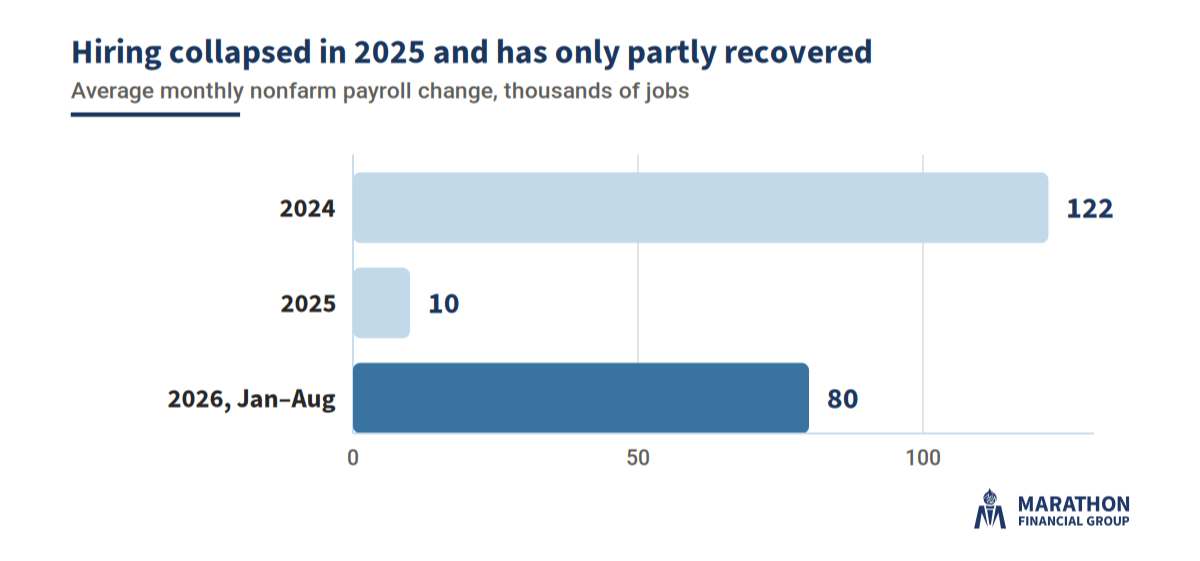
At first glance, the labor market is in good shape. Unemployment held at 4.1% in August, and payroll gains came in well above expectations.
A closer look shows a softer picture. August's beat landed against a weak trend, with job growth averaging just 31,000 a month over the past year. Wage growth continues to decelerate, meaning labor costs are not adding to inflation pressure.
So the labor market is resilient, but it is not showing the signs of an overheating economy that would force the Fed's hand on a hike.
That puts the focus on inflation. We expect rates to stay higher for longer, with another pause the likely outcome on September 16, unless the September 11 CPI report surprises to the upside.
Market Summary
U.S. stocks finished the week essentially unchanged, but the index returns do not tell the full story. There was considerable volatility beneath the surface. Small- and mid-cap stocks also finished near flat, despite participating in a broad rebound during the middle of the week.
Oil prices and interest rates were major drivers of the market's direction. Escalating tensions between the United States and Iran pushed WTI crude above $90 per barrel, while the 10-year Treasury yield rose to 4.78%. Those developments pressured stocks early in the week, particularly growth-oriented and economically sensitive companies.
Markets recovered sharply on Wednesday and Thursday as oil prices stabilized and Treasury yields eased from their highs. The rebound was broad, extending beyond mega-cap technology into financials, materials, and smaller companies.
Friday's stronger-than-expected employment report, however, shifted attention back toward the Federal Reserve and interrupted some of that momentum.
Technology remained an important source of support, although performance was far from uniform. Semiconductor stocks gained for the week, while software stocks experienced significant weakness following several disappointing market reactions to otherwise solid earnings reports.
The takeaway is that investors remain constructive on technology and AI, but expectations are high. Strong results alone have proven to not always be enough. Companies increasingly need to demonstrate that future growth can justify their valuations.
Our view is that the underlying AI investment trend remains intact, but selectivity is becoming increasingly important. We continue to believe the strongest long-term opportunities will be found in companies where industry leadership and growth are supported by strong cash generation and reasonable expectations.
The week's relatively flat finish should not overshadow the bigger picture. The market is still balancing several competing forces, including solid corporate fundamentals, persistent inflation concerns, geopolitical risk, and uncertainty surrounding interest rates. We expect that environment to continue producing significant rotation between sectors and individual companies.
The Economy
This week's economic data continued to show an economy that is growing, although at an uneven pace.
Manufacturing activity remained in expansion territory, while the services sector continued to show solid momentum. The ISM Services Index rose to 55.4%, above expectations, indicating continued strength across a large portion of the economy. At the same time, the report showed that businesses continue to face elevated input costs, which could eventually contribute to persistent inflation.
The labor market provided the week's most impactful news. August nonfarm payrolls increased by 162,000, well above expectations, while the unemployment rate remained at 4.1%. However, the underlying picture was somewhat more balanced than the headline figures suggested. The three-month average of payroll growth remained modest, and year-over-year wage growth continued to ease.
Housing and construction remained more sensitive to higher borrowing costs. Construction spending declined during July, with weakness particularly evident in residential and single-family activity. This continues to illustrate how elevated interest rates are creating different conditions across the economy.
Overall, the economy continues to hold up well, although the strength is becoming increasingly uneven. Employment and services activity continue to provide support, while housing and other interest-rate-sensitive areas remain under greater pressure.
The Fed & Fixed Income
Interest-rate expectations moved sharply during the week as investors weighed two competing concerns: rising oil prices and stronger economic data.
The sharp rise in oil prices initially increased concerns that higher energy costs could make inflation more difficult to control. Treasury yields moved higher early in the week, with the 10-year yield briefly reaching 4.80%.
By Thursday, comments from Fed Governor Christopher Waller provided some relief. Waller acknowledged that inflation remains above the Fed's target but noted that recent data have shown encouraging signs of disinflation. Treasury yields moved lower, and investors increased the probability that the Fed could leave rates unchanged at its September meeting.
That optimism faded following Friday's employment report. Stronger payroll growth and a lower-than-expected unemployment rate pushed the probability of a September rate hike higher, while the two-year and 10-year Treasury yields finished the week at 4.38% and 4.78%, respectively.
The bigger issue for investors remains inflation rather than any single employment report.
The Fed will be watching closely to see whether stronger economic activity and higher oil prices begin to reverse the progress made on inflation. This week's CPI and PPI reports should therefore play an important role in determining the direction of interest-rate expectations.
From a portfolio perspective, this continues to favor companies with healthy balance sheets and the ability to fund growth internally. Businesses that depend heavily on outside financing can become more vulnerable when interest rates remain elevated for an extended period.
Company News & Earnings
Corporate developments highlighted a growing divide within the technology sector.
Dell was one of the week's strongest performers after reporting better-than-expected earnings and raising its outlook for AI-optimized server revenue. The company increased its fiscal 2027 forecast to $74 billion from $60 billion, providing another indication that demand for AI infrastructure remains strong.
Broadcom also reported better-than-expected earnings and revenue, but the stock declined following its report as elevated expectations for AI growth outweighed another strong quarter. The reaction illustrates the increasingly demanding environment for companies benefiting from the AI investment cycle.
The software sector experienced even greater pressure. Palo Alto Networks fell sharply despite beating quarterly expectations and providing an above-consensus outlook. MongoDB, Palantir, and CrowdStrike also declined, suggesting that investors were reassessing valuations following strong gains earlier in the year.
The week ended with a sharp reversal within technology. Semiconductor stocks rallied strongly on Friday, led in part by memory companies such as Sandisk, which benefited from improving DRAM and NAND pricing and continued demand from server infrastructure. Software stocks, however, continued to lag.
Outside technology, consumer earnings remained mixed. Lululemon fell sharply following its results, while Tyson Foods and Campbell's also declined after weaker guidance and outlooks.
This earnings season continues to show how demanding the market has become. Strong growth is still being rewarded, but expectations and valuations are playing a much larger role in how stocks react. Even companies delivering solid results can experience sharp declines when future growth fails to exceed already elevated expectations.
Geopolitics
Geopolitical developments were a major source of volatility throughout the week as tensions between the United States and Iran escalated.
WTI crude oil gained approximately 10% for the week and briefly traded above $90 per barrel following renewed military action and concerns surrounding commercial shipping through the Strait of Hormuz. The increase supported the energy sector, which gained 2.3% and led the S&P 500 for the week.
The rise in oil prices created broader challenges for the market. Higher energy costs can pressure consumers and corporate profit margins while also complicating the inflation outlook. These concerns contributed to weakness across consumer discretionary, industrial, materials, and other economically sensitive sectors.
By the end of the week, oil remained elevated near $91 per barrel, although the absence of further escalation helped prevent another sharp move higher.
The investment question is whether higher energy prices remain elevated long enough to affect inflation and economic growth. Geopolitical events can create substantial short-term volatility, but their longer-term impact is usually determined by whether they produce lasting changes in economic conditions.
Week Ahead
The focus this week will shift firmly towards the macro picture, particularly inflation and the Federal Reserve.
The August Producer Price Index (PPI) and Consumer Price Index (CPI) reports will provide the next major test for interest-rate expectations. Following Friday's stronger-than-expected employment report, investors will be looking closely for evidence that inflation continues to moderate. Softer readings could reduce pressure on the Fed to raise rates in September, while stronger inflation could reinforce the more hawkish outlook that emerged late last week.
With the labor market still resilient and oil prices elevated, the inflation reports will carry added significance. Investors will be particularly focused on whether higher energy costs are beginning to filter through to broader prices.
The earnings calendar will be lighter than recent weeks, although Oracle's upcoming report will provide another important update on enterprise technology, cloud computing, and AI-related spending.
This week's inflation data will help determine whether the market can maintain its current balance between solid economic growth, moderating inflation, and continued earnings strength.
If that balance holds, the Fed may have room to remain patient. If inflation begins moving higher again, particularly alongside elevated energy prices and a resilient labor market, expectations for another rate increase could continue to build.
As always, please reach out to us for any questions and thank you for your trust.
Michael Neill, CFA
This communication is for informational purposes only and does not constitute an offer to sell or a solicitation of an offer to buy any securities. Any references to specific securities are not recommendations and should not be relied upon as investment advice.
Data Sources: TradingEconomics & Bloomberg, LP.