


Key Takeaways
Technology continued to lead the market. The S&P 500 gained 1.2% and the Nasdaq rose 2.1%, with semiconductors and the largest technology companies doing most of the heavy lifting. Smaller companies moved in the opposite direction, with the Russell 2000 down 0.8%.
The rally was fairly narrow. The S&P 500 Equal Weight Index fell 1.0% while the traditional S&P 500 gained 1.2%. That tells us that the market's gains were concentrated in a relatively small number of large companies.
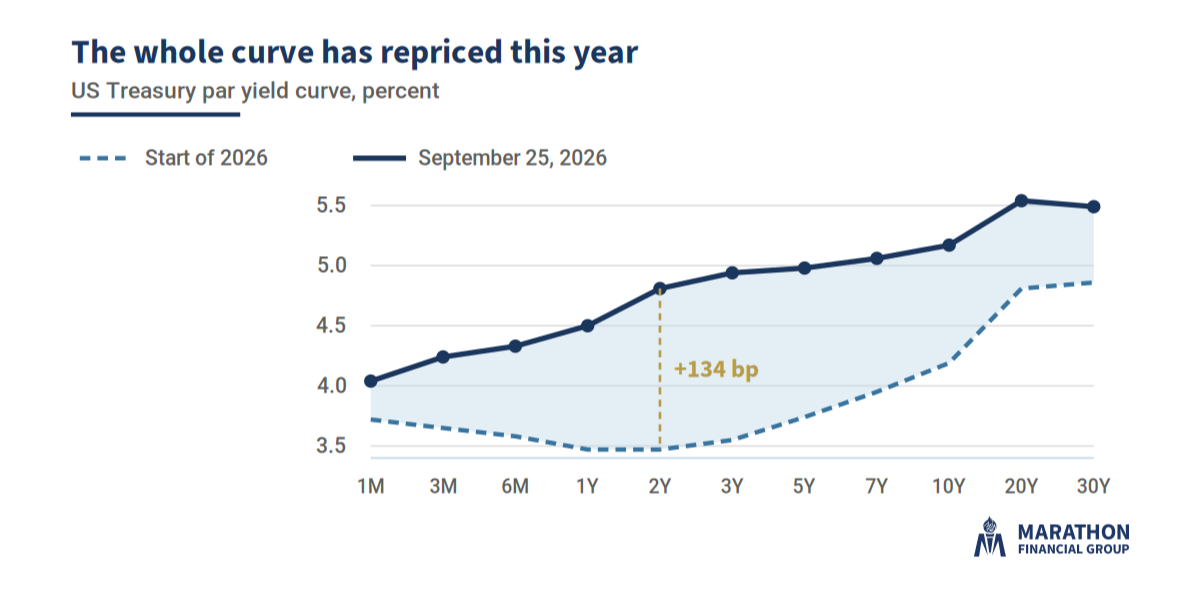
Higher interest rates continued to create pressure. The 10-year Treasury yield rose 16 basis points to 5.16%. That put pressure on small-cap stocks, financials, real estate and other areas that tend to be more sensitive to borrowing costs.
Semiconductors were a major source of strength. Chip stocks rallied sharply during the week, while investors continued to focus on the spending taking place around data centers and new technology infrastructure.
Oil prices moved lower. WTI crude fell nearly 4% to $92.17 as developments surrounding U.S.-Iran negotiations and the Strait of Hormuz eased some concerns about a prolonged energy-price shock.
Chart of the Week
Higher yields reflect several forces at work: persistent inflation, the Fed’s tighter policy, heavy government borrowing, and strong corporate demand for capital. Large technology companies are also issuing significant amounts of debt to fund data centers and AI infrastructure, adding to the competition for investor capital.
Market Summary
The major averages finished higher for the week (S&P 500 +1.2%, Nasdaq +2.1%), but the headline numbers at the index level overshadow some weakness being felt outside of the mega-cap/ AI-dominated trade.
The results were very different outside of the largest companies. The Russell 2000 fell 0.8% and the S&P Mid Cap 400 declined 0.1%.
Technology was clearly where investors wanted to be. The information technology sector gained 3.1%, while the PHLX Semiconductor Index jumped 6.3%. The Vanguard Mega Cap Growth ETF also gained 2.7%.
Broadly, the average stock did not have a particularly good week. The S&P 500 Equal Weight Index fell 1.0%, more than two percentage points behind the traditional S&P 500.
The market can certainly continue to move higher when the largest companies are producing strong earnings, but the narrow leadership tells us that investors are being selective.
The Economy
The economy is holding up reasonably well despite higher interest rates.
Initial jobless claims fell to 197,000 for the week ending September 19, while continuing claims came in at 1.719 million. Layoffs remain relatively low, which suggests that businesses have not yet made significant cuts to their workforces.
Housing was mixed. New-home sales increased 6.4% in August to an annualized 684,000, well ahead of expectations. Sales were still 2% below last year's level, however, and the improvement came alongside lower home prices. Affordability remains a major consideration for buyers.
Business activity was stronger than expected. The preliminary September services PMI rose to 58.7 from 56.5, while manufacturing increased to 57.0 from 53.9. Those are strong readings and helped push Treasury yields higher as investors considered the possibility that the Fed may need to keep rates elevated for longer.
Consumers are a different story. The final September University of Michigan Consumer Sentiment Index came in at 48.1, down from 51.7 in August and 55.1 a year ago. Higher prices continue to weigh on how consumers view both the economy and their own financial situation.
The Fed & Fixed Income
Interest rates were one of the biggest drivers of the market this week.
Stronger economic data and comments from Fed officials pushed Treasury yields sharply higher. The 10-year Treasury yield jumped 14 basis points on Wednesday and reached 5.18% on Thursday before finishing the week at 5.16%, up 16 basis points.
That move in rates was a headwind for smaller companies and other rate-sensitive parts of the market. Technology held up much better, in part because investors continue to place a premium on companies with strong earnings and cash flow.
The market is also putting a higher probability on another Fed rate increase. By Wednesday, the probability of a 25-basis-point hike at the October meeting had risen to 66.4%, compared with 55.4% the day before.
The two-year Treasury yield finished the week at 4.85%, up 10 basis points, while the 10-year ended at 5.16%.
For us, the important point is that the economy is not giving the Fed an obvious reason to ease policy quickly. Economic activity remains solid, while inflation is still above the Fed's target. That leaves interest rates as an important headwind for parts of the stock market, particularly companies that rely heavily on borrowing or have less predictable cash flow.
Company News & Earnings
Technology continued to dominate the market, particularly semiconductors and the companies providing the infrastructure behind the growth in data centers and computing.
Semiconductors: The PHLX Semiconductor Index gained 6.3%. AMD and Intel were among the stronger performers early in the week, while NVIDIA and other chip stocks benefited from continued confidence in spending on new computing infrastructure.
Meta: Meta was another standout. The company's Muse AI agent generated significant investor interest, and the stock gained roughly 36% from the beginning of September through Thursday. Investors are increasingly looking for evidence that the enormous amount being spent on new technology will eventually translate into products, customers and revenue.
Infrastructure: Cloud company Akamai announced an expanded relationship with Anthropic involving an $11.6 billion contractual commitment over seven years, with potential additional commitments that could bring the relationship to as much as $20 billion.
Consumer: Costco gained following better-than-expected fourth-quarter earnings, solid comparable-sales growth and improving membership renewal rates.
Travel: Expedia and Airbnb both came under pressure on concerns that new technology could eventually change the way consumers search for and book travel. Expedia subsequently announced a partnership with Meta's Muse to incorporate technology-assisted trip planning into its platform.
Health care: Moderna and Eli Lilly were among the stronger health-care stocks, helping the sector gain 1.7% for the week.
One thing we're watching closely is the difference between companies that are selling the tools and infrastructure behind this technology and companies that are simply expected to benefit from it. There is a meaningful difference between the two. As valuations remain elevated in parts of technology, we want to see actual earnings and cash flow support the expectations investors are paying for.
Geopolitics
Oil prices remained closely tied to developments involving the U.S.-Iran conflict and the Strait of Hormuz.
WTI initially fell on hopes for diplomatic progress, moved back above $96 as uncertainty returned, and then declined again late in the week as reports suggested that discussions surrounding a potential reopening of the Strait were progressing. WTI finished at $92.17, down nearly 4% for the week.
Lower oil prices were a positive development for inflation expectations. Energy remains something we are watching, however, because a sustained increase in oil prices would put additional pressure on consumers and could make the Fed's inflation problem more difficult.
Week Ahead
The biggest economic report this week will be the August Personal Income and Spending report, including the PCE Price Index, which is scheduled for Wednesday.
That will give investors another important look at inflation ahead of the Fed's October meeting. The market will also continue to pay close attention to Treasury yields and comments from Fed officials.
Micron earnings on Wednesday will be a key point as investors gauge supply and demand stability for memory.
Our Take
The market continues to reward a relatively small group of large technology companies, while higher interest rates are creating more pressure elsewhere.
We don't view that as a reason to chase what has worked in the short term. Instead, it reinforces the way we approach portfolio construction. We want to own businesses that we believe can continue to grow earnings and free cash flow, have healthy balance sheets and are operating in industries where they can maintain a competitive advantage.
With the 10-year Treasury yield above 5% and market leadership relatively narrow, we're paying close attention to what we're actually getting for the price we pay. Strong companies can still be attractive investments, but valuation matters, particularly when elevated yields are competing with risk premiums.
As always, please reach out to us for any questions and thank you for your trust.
Michael Neill, CFA
This communication is for informational purposes only and does not constitute an offer to sell or a solicitation of an offer to buy any securities. Any references to specific securities are not recommendations and should not be relied upon as investment advice.
Data Sources: Marathon Financial Group, TradingEconomics & Bloomberg, LP.