


Key Takeaways
- Stocks declined as oil and Treasury yields moved higher. WTI crude climbed above $100, while rising interest rates created a difficult backdrop for equities.
- Markets increasingly priced in a Fed rate hike. Stronger inflation data pushed the probability of a hike above 85%.
- Technology held up relatively well. Semiconductor and AI infrastructure stocks continued to attract buyers despite broader market weakness.
- Small- and mid-cap stocks lagged significantly. Their greater sensitivity to borrowing costs became more apparent as rates moved higher.
- Geopolitical tensions remained the biggest near-term risk. With the Fed meeting next week, monetary policy will be the market's central focus.
Market Summary
U.S. stocks finished lower during the holiday-shortened week as higher oil prices, rising Treasury yields, and growing expectations for tighter monetary policy weighed on sentiment.
Energy markets were a major source of pressure. WTI crude climbed roughly 10% and finished above $100 per barrel as escalating U.S.-Iran tensions raised concerns about disruptions to regional supply and shipping through the Strait of Hormuz. Energy stocks benefited, but higher fuel costs created a broader challenge for consumers, businesses, and inflation-sensitive areas of the market.
Higher interest rates added to the pressure. The 10-year Treasury yield rose 20 basis points to 4.98%, while the two-year yield climbed to 4.64%. The move was particularly difficult for smaller companies and other businesses whose valuations are more sensitive to borrowing costs.
Technology was a relative bright spot, although performance varied considerably. Semiconductor stocks gained 0.8% for the week, while software fell 2.9%. Friday's rebound in semiconductor and AI infrastructure companies was encouraging and showed that investors remain willing to support areas tied to long-term technology spending, even as higher rates put pressure on valuations.
The week's decline was driven more by macroeconomic and geopolitical forces than by a meaningful deterioration in corporate fundamentals. Volatility can increase quickly when oil prices, interest rates, and monetary-policy expectations are all moving at the same time, even when the underlying earnings and economic backdrop remains reasonably healthy.
For our portfolios, this continues to reinforce the importance of focusing on companies with strong fundamentals rather than simply reacting to short-term market moves. Healthy balance sheets, strong cash generation, and durable earnings growth can provide an important advantage when financial conditions become less supportive.
The Economy
The economic picture remained mixed. Weekly jobless claims held near historically low levels, suggesting employers continue to be reluctant to reduce headcount. At the same time, existing home sales remained under pressure from elevated mortgage rates and limited inventory, particularly for lower-priced homes.
Consumer credit increased more than expected in July, while small-business optimism slipped in August. Households and businesses remain active, but higher costs and borrowing rates are weighing on confidence.
Productivity provided a more encouraging signal. Second-quarter productivity growth was revised to 1.4%, while unit labor costs rose only 1.3%. Improving productivity can help businesses absorb wage pressures without passing the full increase through to customers, providing an important counterweight to inflation.
Overall, the economy continues to expand, although the effects of higher rates are becoming more visible in housing and other interest-sensitive areas.
The Fed & Fixed Income
The week's inflation data materially changed expectations for the Federal Reserve.
Producer prices rose 0.4% in August, in line with expectations, while core PPI increased 0.2%. Although the core reading was slightly better than anticipated, upward revisions to July data and faster year-over-year producer-price growth reinforced concerns that inflation may remain sticky.
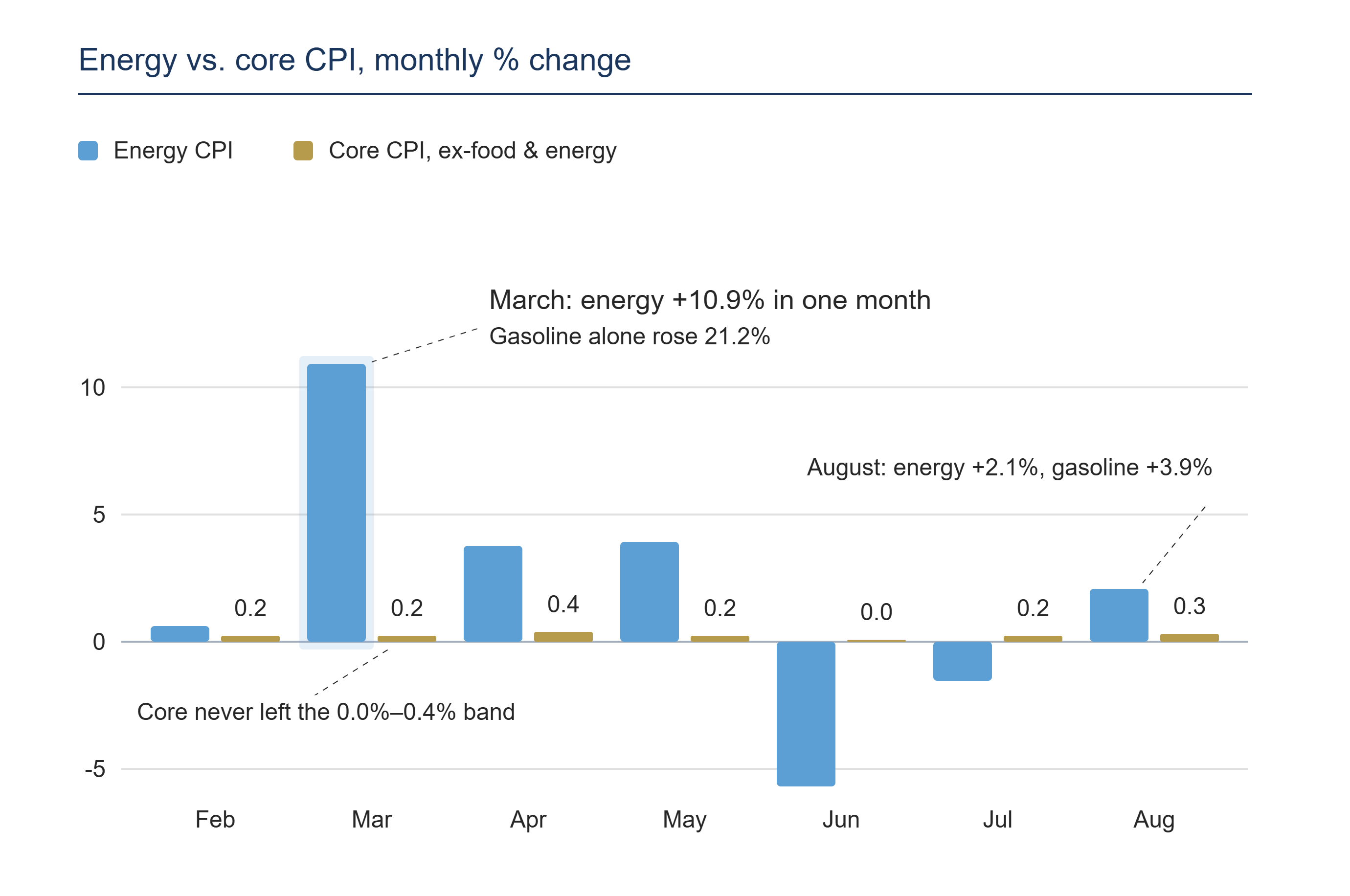
Friday's CPI report added to those concerns. Headline inflation increased 0.4% for the month, while core CPI rose 0.3%, slightly above expectations. Following the report, the market-implied probability of a 25-basis-point rate hike at the upcoming FOMC meeting climbed to 86.5%.
Treasury yields responded accordingly. The two-year yield finished at 4.64%, up 26 basis points for the week, while the 10-year yield reached 4.98%, a 20-basis-point increase. The speed of the move is a reminder of how quickly inflation data can affect both monetary-policy expectations and asset valuations.
Company News & Earnings
Technology remained one of the more resilient areas of the market, with several developments reinforcing the continued investment in AI infrastructure.
Intel and AMD were among the semiconductor standouts. Intel rallied following positive analyst commentary and reports of potential price increases, while AMD benefited from improving expectations for AI demand and its server CPU opportunity. Qualcomm also gained after announcing a multi-year agreement with Amazon covering custom silicon and optical connectivity, providing another indication of expanding data-center demand.
The optical infrastructure market received a significant boost from a multi-billion-dollar agreement between Verizon and Corning, covering more than 80 million miles of high-density fiber and connectivity solutions through 2032.
Oracle was another important development. While the stock ultimately declined following its earnings report, the results provided encouraging evidence for the broader AI infrastructure theme. Cloud infrastructure revenue increased 121% year over year, while the company reported more than $30 billion in new AI-cloud contracts and maintained its plans for significant capital investment.
Those developments helped lift Dell and Hewlett Packard Enterprise, as investors anticipated continued demand for servers, networking equipment, and storage.
Geopolitics
Geopolitical developments were arguably the week's biggest source of market volatility.
Fighting between the United States and Iran intensified, with attacks involving Iranian oil tankers and military vessels raising concerns about disruptions to energy exports and shipping through the Strait of Hormuz.
WTI crude ultimately climbed roughly 10% for the week, briefly exceeding $102 per barrel before retreating modestly on Friday. Energy stocks benefited from the move, while higher fuel costs put pressure on transportation, consumer, industrial, and other energy-intensive businesses.
The situation also has a direct connection to monetary policy. A sustained increase in oil prices could feed into broader inflation, making the Fed's job more difficult and potentially keeping interest rates higher for longer.
The investment question is whether elevated energy prices persist long enough to materially affect inflation, economic growth, and corporate profitability.
Week Ahead
The Federal Reserve's upcoming meeting will be the central focus, with markets now pricing in an approximately 86.5% probability of a 25-basis-point rate hike. Investors will be watching not only the decision itself, but also the Fed's updated economic projections and guidance on the path of future rates.
The bigger issue is whether this represents a one-time adjustment or the beginning of a more restrictive policy cycle. With oil above $100 and inflation readings proving somewhat sticky, the Fed faces a difficult balance between containing prices and avoiding unnecessary pressure on economic growth.
Investors will also continue monitoring oil prices, Treasury yields, and AI-related technology stocks. The market's ability to rebound Friday despite higher rate expectations was encouraging, particularly as semiconductor and infrastructure companies regained momentum.
The coming week should provide a clearer picture of how the Fed intends to respond to the combination of resilient employment, elevated energy prices, and persistent inflation.
From our perspective, higher rates and geopolitical uncertainty may create additional volatility, but they do not necessarily change the longer-term investment case for financially strong companies.
As always, please reach out to us for any questions and thank you for your trust.
Michael Neill, CFA
This communication is for informational purposes only and does not constitute an offer to sell or a solicitation of an offer to buy any securities. Any references to specific securities are not recommendations and should not be relied upon as investment advice.
Data Sources: TradingEconomics & Bloomberg, LP.
Chart Sources: BLS, August 2026 CPI, Released September 11