


Key Takeaways
- Technology continued to lead, while much of the broader market struggled. Semiconductor and mega-cap technology stocks helped keep the Nasdaq in positive territory, but most sectors and smaller-cap stocks remained under pressure.
- Higher Treasury yields continued to be a major headwind. The 10-year Treasury yield reached 5.28%, putting pressure on areas of the market that are more sensitive to borrowing costs and higher interest rates.
- Market breadth remains a concern. The largest technology and semiconductor companies continue to account for a disproportionate share of the market's gains, while the average stock has had a much tougher time.
- The economy is showing some signs of slowing. September payroll growth was just 29,000 and unemployment moved up to 4.2%. Consumer confidence also remains subdued, although manufacturing and business spending have held up reasonably well.
- September was a good reminder that the S&P 500 doesn't always tell the whole story. The headline index held up relatively well, but underneath the surface, many areas of the market experienced meaningful weakness.
Market Summary
Stocks finished the week mixed as higher Treasury yields continued to weigh on much of the market. Technology and semiconductor stocks provided enough support to keep the Nasdaq higher, but the broader market remained under pressure.
The market was weaker than the major indexes suggested. The Equal-Weight S&P 500 fell 0.7%, compared with a 0.3% decline in the traditional S&P 500, and eight of the 11 sectors finished lower. Health care and financials were among the weakest areas, while housing-related stocks continued to feel the effects of higher borrowing costs.
Technology was the exception, gaining 1.4%, while the semiconductor index rose 3.7%. Continued enthusiasm around AI infrastructure and the earnings potential of companies benefiting from that investment cycle has kept investors bullish.
From our perspective, the bigger issue is not simply whether the market is going up or down, but how broad that strength really is. A relatively small group of companies can keep the major indices looking healthy even while the average stock struggles. That makes company fundamentals increasingly important, particularly in an environment where higher rates are putting more pressure on businesses with weaker balance sheets, less predictable cash flow, or aggressive valuations.
The Economy
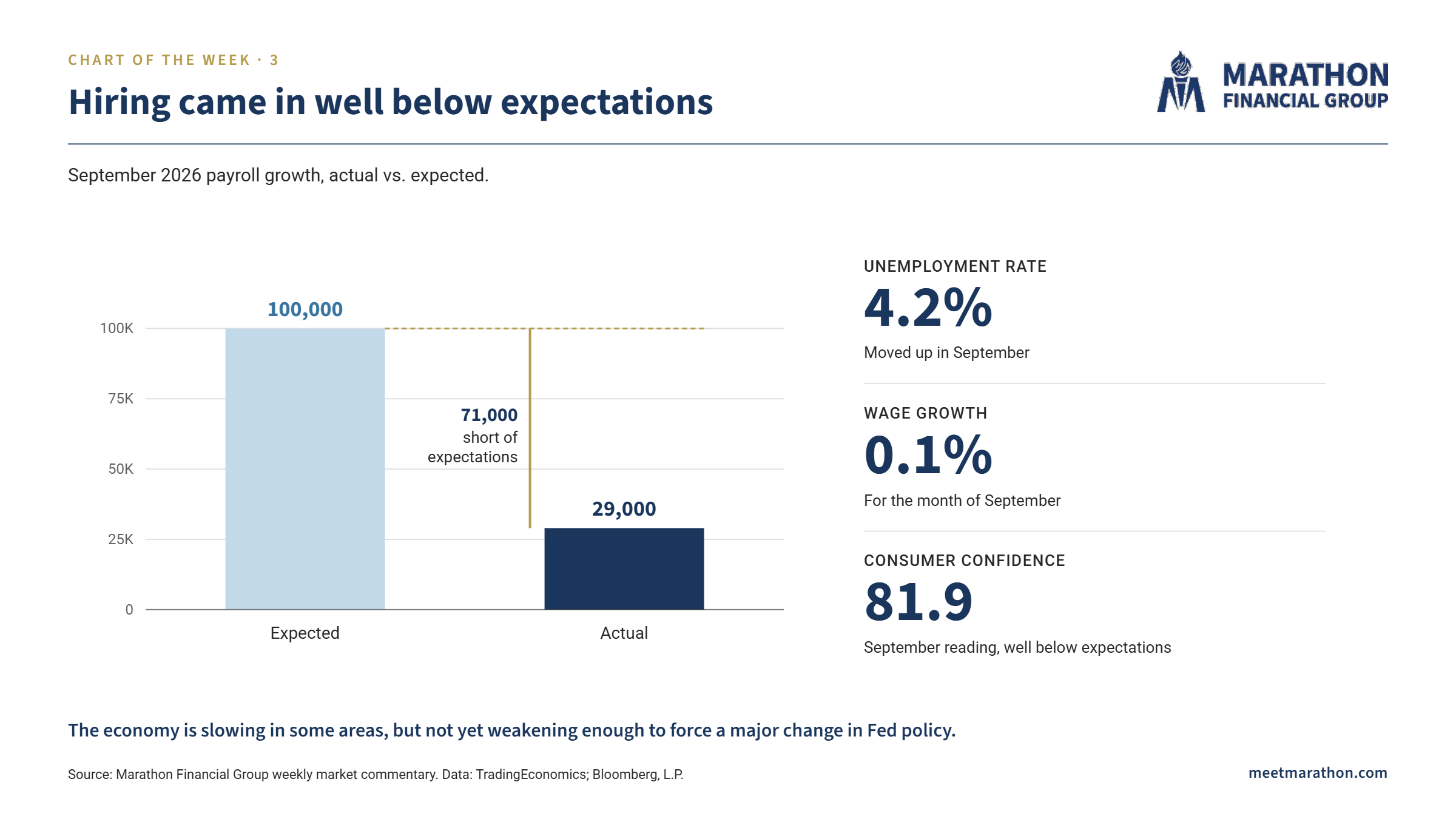
Economic data gave us a mixed picture this week. The September employment report was notably weaker than expected, with payrolls increasing by just 29,000 versus expectations of 100,000. The unemployment rate also moved up to 4.2%, while wage growth slowed to 0.1% for the month.
The softer employment report initially pushed Treasury yields lower and reinforced expectations that the Fed would leave interest rates unchanged at its October meeting.
At the same time, we aren't seeing signs of a broad economic contraction. Manufacturing remained in expansion territory, construction spending was stronger than expected, and initial jobless claims remained near historically low levels. Business spending has also held up reasonably well.
The consumer is a little more concerning. Consumer confidence fell to 81.9 in September, well below expectations, as higher prices continue to weigh on how households view both current conditions and the outlook.
Taken together, the data point to an economy that is slowing in some areas, but not yet weakening enough to force the Fed into a major change in policy. That leaves the Fed in a difficult position. The labor market is becoming less supportive, but inflation remains above target and economic activity is still holding up well enough to keep inflation concerns on the table.
The Fed & Fixed Income
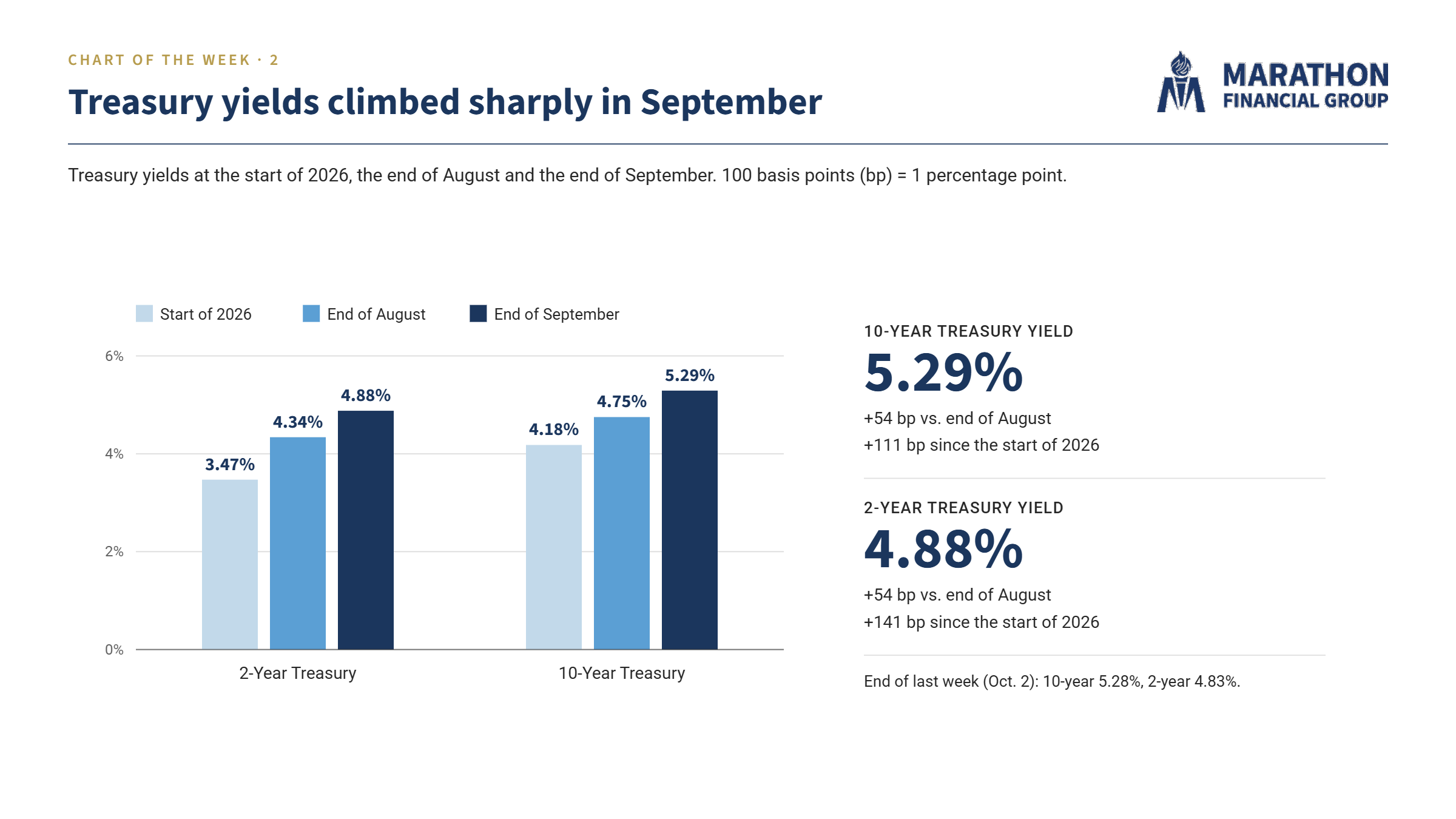
Interest rates remained one of the biggest challenges for stocks this week. The 10-year Treasury yield climbed another 10 basis points to 5.28%, its highest level of the year, while the 2-year yield finished at 4.82%.
The outlook for the October Fed meeting became somewhat less restrictive as the week progressed. Cooler-than-expected PCE inflation, comments from Fed officials favoring patience, and the weaker employment report all reduced expectations for another immediate rate increase. By Thursday, the market was assigning a 76.2% probability to the Fed leaving rates unchanged in October.
What stands out to us, however, is that longer-term Treasury yields remain elevated even as expectations for another near-term Fed hike have come down. That tells us the bond market is responding to more than just Fed policy. Persistent inflation, relatively solid economic activity, significant government borrowing, and the amount of Treasury issuance are all contributing to higher long-term yields.
For investors, higher rates matter in a few different ways. They make bonds and cash alternatives more attractive, increase borrowing costs for businesses and consumers, and put pressure on the value investors are willing to pay for future earnings.
That helps explain an important theme we've seen this year: large, profitable technology companies have generally held up better than smaller and more economically sensitive businesses.
Company News & Earnings
Technology and semiconductor companies continued to be the primary source of market strength. NVIDIA and other semiconductor names benefited from continued expectations for strong AI-related demand, while Micron, Accenture, and Synopsys all had notable developments during the week.
Micron's results and outlook reinforced the strength of demand for memory tied to AI infrastructure. Accenture's stronger bookings also suggested that AI is increasingly becoming a source of actual revenue growth rather than simply a potential threat to existing business models.
At the same time, we're seeing how high expectations can make it difficult for companies to impress investors, even when the underlying results are good. Electronic component manufacturer, Jabil, for example, fell sharply despite reporting better-than-expected results and an upbeat outlook. With so much enthusiasm surrounding AI-related growth, companies are being held to increasingly high expectations – another theme we have grown accustomed to over the last few years.
Outside of technology, Tesla benefited from stronger-than-expected deliveries, while Nike fell sharply following another disappointing outlook. Western Digital and Seagate also came under pressure as concerns about increased hard-drive capacity raised questions about future pricing and margins.
For us, these moves reinforce why we try to look beyond a single quarter's earnings report. Over the long run, we want to know whether a company has a durable competitive advantage and a realistic path toward sustained earnings growth.
Geopolitics
Geopolitical developments surrounding the U.S.-Iran conflict and the Strait of Hormuz continued to cause significant swings in oil prices. WTI moved sharply throughout the week before finishing around $91 per barrel. A coordinated G7 release of 100 million barrels through the IEA helped push oil lower on Friday.
Oil remains an important variable for both markets and the economy. A sustained increase in energy prices could put additional pressure on inflation while also reducing consumers' purchasing power. For now, the decline in crude from its recent highs is encouraging, although the situation remains fluid.
September: A Month in Perspective
September was a good reminder that the headline S&P 500 doesn't always tell us what's really happening underneath the surface.
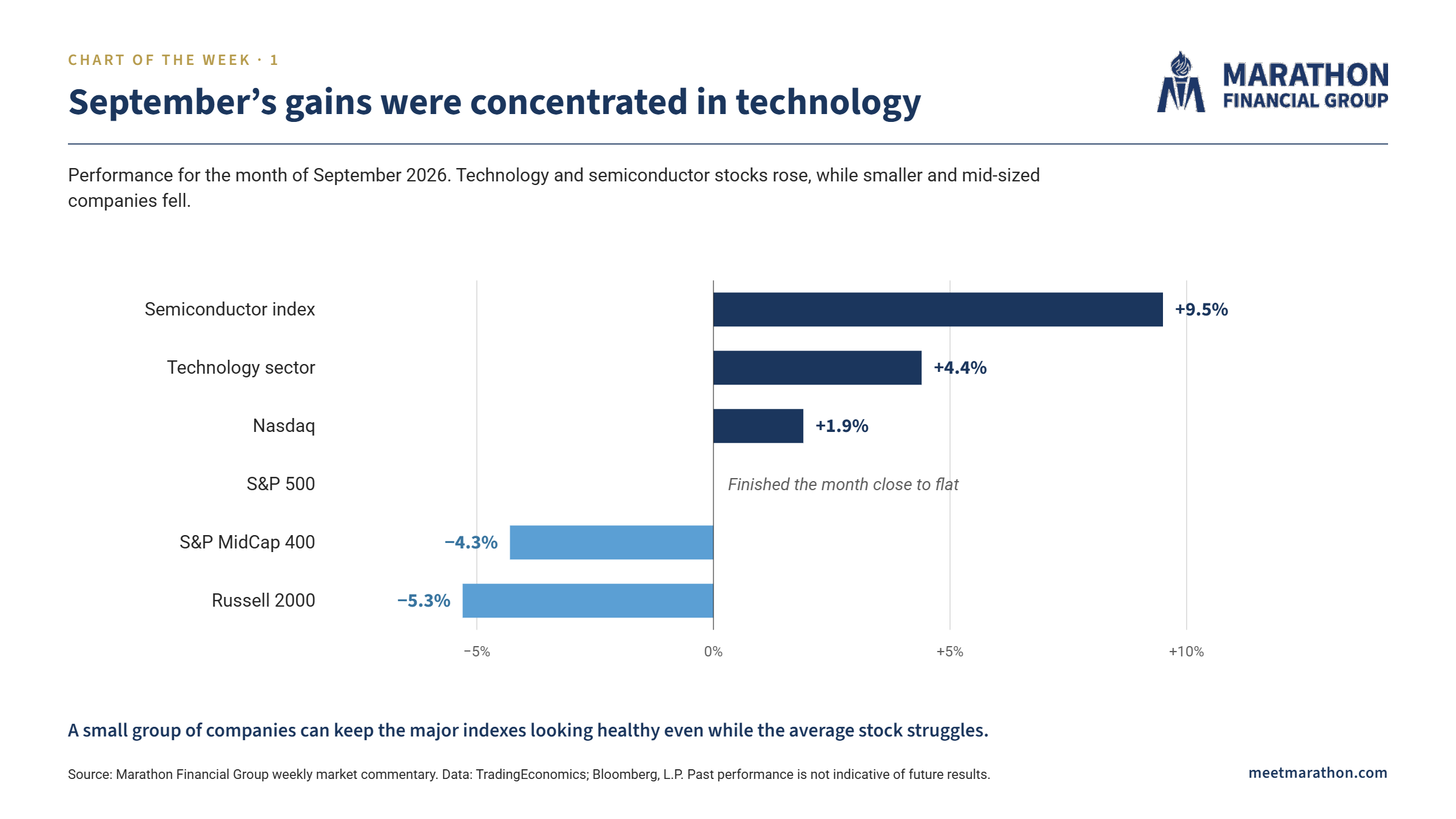
The S&P 500 finished the month relatively close to flat, while the Nasdaq gained 1.9%. At first glance, that might suggest a fairly uneventful month. But the story was very different beneath the surface.
Mega-cap technology and semiconductor stocks performed well, while the average stock and many economically sensitive areas of the market experienced meaningful declines. By the end of September, the Russell 2000 was down 5.3% for the month and the S&P Mid Cap 400 was down 4.3%.
Much of that divergence came down to interest rates. The 2-year Treasury yield rose approximately 55 basis points during September, while the 10-year yield increased roughly 56 basis points, finishing around 5.30%. Higher yields created a significant headwind for smaller companies, housing, rate-sensitive sectors, and other areas where financing costs and valuation assumptions matter more.
Technology and semiconductor stocks, however, continued to perform well. The technology sector gained 4.4% during the month, while the semiconductor index rose 9.5%. Mega-cap growth stocks also remained strong, and that leadership was enough to keep the Nasdaq positive despite considerable weakness elsewhere.
This created an increasingly concentrated market. When the largest companies are performing well, the traditional S&P 500 can appear relatively healthy even when a much larger percentage of individual stocks are declining. That's exactly what we've seen.
We don't necessarily view concentrated leadership as a bad thing. Many of the companies leading the market have very strong earnings, balance sheets, cash flow, and competitive advantages. Some of the strength in technology is also being supported by real fundamental growth, particularly the enormous amount of capital being invested in AI infrastructure.
The concern is simply that the headline indices can make market conditions look better than they actually are for the average company.
September also showed why higher rates matter so much to the broader market. Rising yields make bonds and cash alternatives more attractive, increase borrowing costs, and put pressure on the valuation investors are willing to place on future earnings. Businesses that depend heavily on financing, or whose valuations rely heavily on earnings far into the future, tend to feel that pressure first.
There are a few reasons to be encouraged heading into October. Cooler-than-expected PCE inflation and a materially weaker employment report have reduced expectations for another immediate Fed hike. Small- and mid-cap stocks also showed some signs of improving participation toward the end of September.
The bigger question for us is whether longer-term Treasury yields begin to stabilize. If they do, we could see broader participation beyond the mega-cap technology companies that have carried much of the market's performance. If yields remain elevated, we would expect the environment to continue favoring companies with strong balance sheets, durable cash flow, pricing power, and visible earnings growth.
For long-term investors, September was less about whether the S&P 500 finished the month up or down and more about what was happening underneath the surface. It was another reminder that diversification, discipline, and a focus on the fundamentals of the businesses we own remain important.
Week Ahead
As we move into October, we'll be watching two things particularly closely: whether the softer employment data and cooler inflation readings are enough to keep the Fed on hold, and whether longer-term Treasury yields begin to come down from elevated levels.
We'll also be watching the economy for signs that growth is slowing enough to ease inflation pressures without tipping into a more significant downturn.
Earnings will become increasingly important as third-quarter reporting season approaches. After several months of AI and semiconductor stocks driving much of the market's leadership, we're looking for evidence that earnings growth is beginning to broaden beyond technology.
Ultimately, the question we keep coming back to is whether current valuations are supported by durable earnings and free-cash-flow growth. For long-term investors, that's likely to matter much more than the market's short-term headlines.
As always, please reach out to us for any questions and thank you for your trust.
Michael Neill, CFA
This communication is for informational purposes only and does not constitute an offer to sell or a solicitation of an offer to buy any securities. Any references to specific securities are not recommendations and should not be relied upon as investment advice.
Data Sources: Marathon Financial Group, TradingEconomics & Bloomberg, LP.