


Key Takeaways
Technology stocks led the market pullback. The Philadelphia Semiconductor Index fell 11.4% for the week as concerns about AI infrastructure spending, debt financing, and competition from Chinese chipmakers weighed on the sector.
Inflation is becoming harder to ignore. September CPI and PPI came in hot, oil climbed above $100 per barrel, and markets began pricing in a greater chance of another Fed rate hike.
The economy remains resilient, but that complicates the Fed’s job. Retail sales exceeded expectations and jobless claims remained low, suggesting demand is holding up even as inflation pressures build.
Lower Treasury yields offered little relief. The 10-year yield fell 14 basis points to 5.10% for the week, yet growth stocks continued to struggle as concerns about valuations and the returns on AI spending encumbered sentiment.
Market Summary
Stocks had a difficult week as concerns about inflation, higher oil prices, and the enormous cost of building out AI infrastructure weighed on the market. The Nasdaq bore the brunt of the selling, while the Dow held up considerably better, helped by strength in more defensive areas.
The major averages finished the week mixed, with the the Philadelphia Semiconductor Index was particularly weak, falling 11.4% as investors reassessed how much capital is being committed to AI infrastructure and whether the companies funding that expansion can earn an adequate return.
Cloud computing darling, CoreWeave, became a focal point for those concerns. Questions surrounding its debt obligations and the cost of financing data center expansion added pressure to chipmakers, equipment suppliers, and other companies tied to AI spending.
Reports of increasing competition from Chinese memory-chip manufacturers added another challenge for the semiconductor industry. Apple was a notable exception, supported by encouraging reports about demand for its new iPhone Duo.
The selling was not entirely indiscriminate. Energy, health care, and consumer staples held up relatively well, while Thursday brought a meaningful rebound across smaller companies and the equal-weighted S&P 500. That recovery suggested there was still buying interest outside the largest technology stocks. However, Friday’s decline erased much of that progress, leaving the market on a cautious footing heading into the next round of earnings reports.
The Economy
The week's economic data presented a mixed picture: inflation is moving in the wrong direction, but consumer spending and employment remain relatively firm.
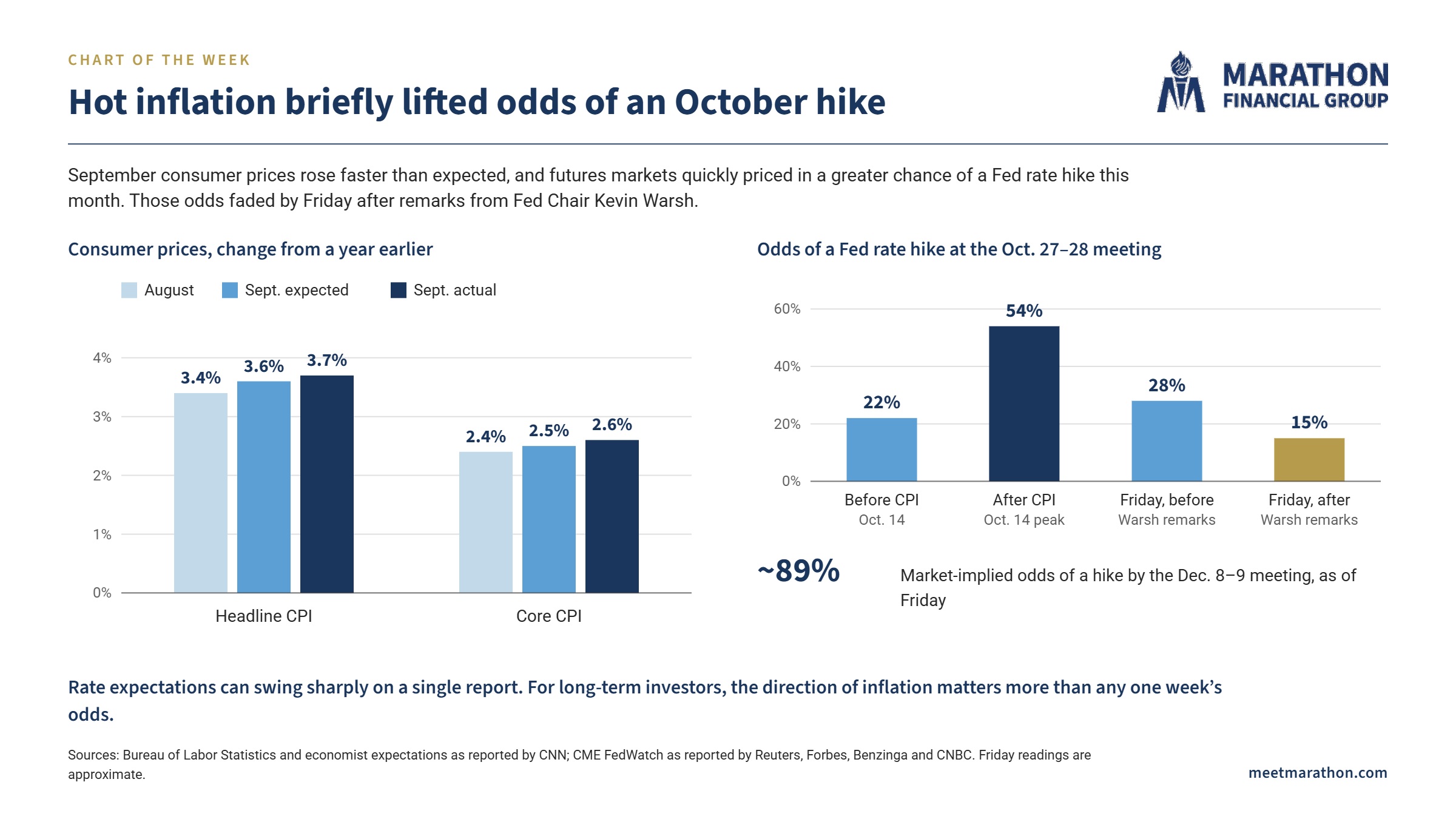
September consumer prices rose 3.7% from a year earlier, up from 3.4% in August. Core CPI, which excludes food and energy, accelerated to 2.6% from 2.4%. On a monthly basis, headline CPI increased 0.6%, while core CPI rose 0.3%, slightly above expectations. Higher energy prices were a major contributor, but the increase in core inflation suggests the pressure is not limited to gasoline and oil.
Producer prices were even more concerning. Headline PPI rose 1.3% for the month, well above the 0.5% expected, while core PPI increased 0.7%, compared with expectations of 0.3%. These figures reinforce the possibility that businesses are facing renewed cost pressures, some of which could eventually be passed along to consumers.
At the same time, consumers have not pulled back. September retail sales increased 0.8%, comfortably ahead of expectations for 0.3%, with spending strength extending beyond automobiles. Initial jobless claims remained low at 199,000, pointing to limited layoffs, while industrial production rose 0.7%.
Taken together, the data suggest the economy is still growing, but inflation is proving more persistent than policymakers would like. That creates a difficult balance for the Federal Reserve: economic activity has not weakened enough to clearly justify easier policy, while rising prices make further rate cuts harder to defend.
The Fed & Fixed Income
Inflation was the week's biggest development for interest rates. Following the CPI report, the implied probability of a 25-basis-point rate hike at the October Fed meeting briefly climbed from 22.1% to nearly 50%. The hotter-than-expected PPI report the following day reinforced concerns that inflation could remain elevated.
Treasury yields initially rose after the CPI release but reversed course as the week progressed. The two-year Treasury yield finished at 4.74%, down five basis points for the week, while the 10-year yield ended at 5.10%, down 14 basis points. The decline in longer-term yields offered some relief to rate-sensitive areas, including housing, but it did little to reverse the broader selloff in growth stocks.
Lower yields typically support valuations by reducing the rate used to discount future earnings. This week, however, investors were focused on more than interest rates. They were also questioning the amount of debt being used to finance AI infrastructure, the potential returns on that spending, and whether current valuations leave enough room for disappointment.
In other words, lower yields alone may not be enough to support technology stocks if confidence in future earnings and capital spending begins to weaken. The next challenge for the Fed is determining whether the recent inflation readings represent another sustained pickup in price pressures or a temporary acceleration driven in part by energy costs.
Company News & Earnings
AI infrastructure and semiconductors remained under pressure. CoreWeave’s financing concerns were a major source of uncertainty, while Micron, AMD, and SanDisk posted declines.
Reports that Chinese chipmaker CXMT plans to produce next-generation memory chips raised additional questions about competition in a market where U.S. and South Korean manufacturers have benefited from strong AI-related demand. Dell and Hewlett Packard Enterprise also fell sharply after analyst downgrades.
Thursday offered a brief reprieve. Taiwan Semiconductor Manufacturing, one of our key holdings, reported better-than-expected results and provided revenue guidance above consensus, although the news did not immediately lift the broader semiconductor group.
CoreWeave shares also recovered after NVIDIA CEO Jensen Huang reportedly said the company's financial position was improving and that it did not need a financial backstop. The rebound was short-lived, with selling returning on Friday.
The broader question is whether AI-related capital spending can ultimately generate returns that justify the scale of investment. Demand for computing capacity may remain strong, but investors are increasingly distinguishing between companies positioned to benefit from that demand and those taking on substantial financing obligations to meet it – a key reason why fundamentals remain important. That distinction could become more important as earnings reports provide additional detail on spending plans, customer commitments, and profitability.
Apple stood out against the technology selloff. Reports that the new iPhone Duo sold out within minutes of preorders opening helped the stock outperform its peers. Investors were rewarding evidence of product demand while becoming more cautious about companies whose valuations depend heavily on the continued expansion of AI infrastructure spending.
Banks kicked off the earnings season with mixed results. JPMorgan, Goldman Sachs, Citigroup, and Wells Fargo were among the major firms reporting early in the week. Bank of America faced pressure after weaker trading and investment banking revenue, an earnings miss, and a regulatory charge offset continued growth in net interest income. Morgan Stanley exceeded earnings expectations, while BlackRock also reported results. The reports helped clarify how trading activity, lending, and investment banking are holding up in the current economic environment.
Energy stocks benefited from rising crude prices. WTI crude climbed to $101.40 per barrel by Friday, contributing to strength in the energy sector. Refiners including Marathon Petroleum and Valero also reached record highs earlier in the week. However, higher oil prices are a double-edged sword: they can support energy-sector earnings while adding to inflation and putting pressure on household budgets and transportation costs.
Geopolitics
Developments in the Middle East added another layer of uncertainty. Escalating tensions involving Saudi Arabia and Houthi forces, along with concerns about the possibility of renewed U.S. and Israeli action involving Iran, pushed oil prices higher. WTI crude rose nearly $10 per barrel over the week, finishing Friday at $101.40.
The concern extends beyond the energy sector as a sustained rise in oil prices could feed into transportation and production costs, complicate the inflation outlook, and leave consumers with less money to spend elsewhere. That would make the Fed’s job more difficult at a time when price pressures are already accelerating.
For markets, the combination of higher energy prices and persistent inflation is particularly challenging because it can put pressure on both corporate margins and the interest-rate outlook. The duration of the oil rally will matter: a temporary spike may have a limited economic impact, but a prolonged increase would be harder for businesses and consumers to absorb.
Week Ahead
The next round of third-quarter earnings will be important in determining whether the recent selloff is a short-term reset or a more meaningful reassessment of expectations.
We will be paying particular attention to three areas:
AI spending and returns: Results and commentary from technology companies should provide more insight into the pace of data-center investment, customer demand, financing needs, and the path to profitability. Strong demand alone may not be enough if investors become less comfortable with the cost of delivering it.
Inflation and interest rates: After hotter-than-expected CPI and PPI reports, the market will be looking for signs that price pressures are stabilizing. Oil prices and Treasury yields will remain important variables in how markets interpret the outlook for Fed policy.
Bank earnings and the broader economy: Results from major financial institutions should offer a useful read on consumer and business activity, credit conditions, and the health of capital markets.
Our view is that the week's decline calls for a closer look at what investors are paying for future growth, particularly in the AI supply chain. The long-term opportunity in AI may remain significant, but the investment case for each company still depends on its ability to turn spending into sustainable cash flow and earnings. As earnings season progresses, we will be looking for evidence of that conversion rather than assuming that every company associated with AI will benefit equally.
As always, please reach out to us for any questions and thank you for your trust.
Michael Neill, CFA
This communication is for informational purposes only and does not constitute an offer to sell or a solicitation of an offer to buy any securities. Any references to specific securities are not recommendations and should not be relied upon as investment advice.
Data Sources: Marathon Financial Group, TradingEconomics & Bloomberg, LP.