


Inflation Pressures Challenge AI-Driven Rebound; NVIDIA Earnings and Anthropic IPO in Focus
Market Overview
Stocks rallied early in the week but gave back some of those gains as inflation concerns, rising Treasury yields, and uncertainty around the AI trade weighed on sentiment. The S&P 500 gained 2.5% for the week, while the Nasdaq Composite advanced 2.3%, although both finished well below their midweek highs. The initial rebound was driven by renewed confidence in AI infrastructure spending and easing concerns surrounding the U.S.-Iran conflict. Selling picked up again later in the week, particularly across semiconductor stocks.1
AI remained a major driver of market activity. Strong results from CoreWeave helped restore confidence in demand for AI infrastructure, with a growing backlog, improving margins, and a stronger outlook offering some reassurance about the economics of the buildout. However, that optimism was offset by uncertainty surrounding NVIDIA's leadership, renewed questions about chip-export restrictions, and concerns about how quickly companies will see returns on their AI investments. Semiconductor stocks ultimately finished lower despite a strong rebound on Wednesday.
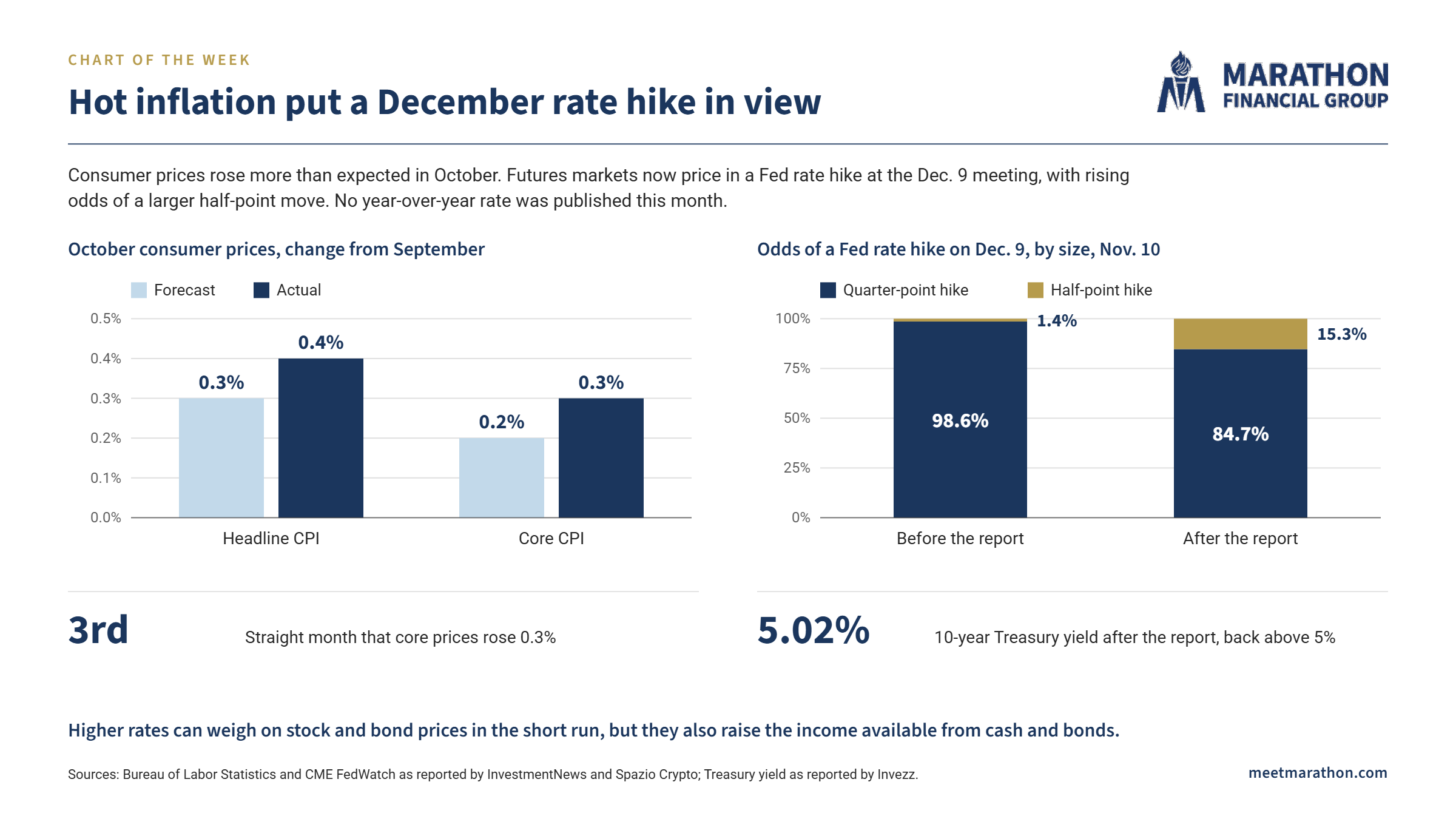
Inflation and interest rates also weighed on stocks. October CPI came in hotter than expected, while producer prices remained elevated despite a softer headline reading. The reports added to concerns that inflation may be harder to bring back toward the Fed's 2% target than previously expected. Treasury yields moved sharply higher, with the 2-year yield climbing 36 basis points to 4.89% and the 10-year rising 29 basis points to 5.15%. Markets also began pricing in the possibility of a 50-basis-point rate hike in December.2
Oil prices moved around throughout the week as investors weighed mixed signals about a potential diplomatic resolution to the U.S.-Iran conflict. WTI crude briefly fell below $84 per barrel before recovering to $88.79 on Thursday, adding another variable to the inflation outlook.
The market's rebound shows that investors are still willing to step in when stocks pull back, but higher interest rates and uncertainty around AI are making it harder for rallies to hold.
Interest Rates, Inflation & the Fed
The October inflation reports offered little relief. Consumer prices rose 0.4% during the month, above expectations, while core CPI increased 0.3%. Producer prices also rose 0.3%, in line with estimates, but upward revisions to September and elevated annual readings pointed to continued price pressure. Final demand producer prices were up 6.5% from a year earlier, the largest annual increase since November 2022, while core producer prices rose 5.0%.3
The latest data have shifted expectations for Federal Reserve policy. Markets are now pricing in a December rate hike, with some speculation that the increase could reach 50 basis points. Fed officials have also reiterated that more progress is needed to bring inflation back to target. In response, Treasury yields moved higher, with the 10-year reaching 5.15%, its highest settlement in more than four weeks.4
Higher yields make stocks less attractive relative to bonds and put added pressure on companies whose valuations rely heavily on earnings growth several years into the future. They also raise borrowing costs for households and businesses, creating another potential headwind for consumer spending and economic growth.
Company News & AI Developments
CoreWeave was one of the week's biggest stories, with shares surging after the company reported better-than-expected revenue and raised its fiscal 2026 outlook. Its $132.5 billion backlog, improving margins, and additional details around customer prepayments and financing helped ease concerns about the cost of expanding AI infrastructure. The results also lifted sentiment toward related companies, including Dell, Micron, Oracle, and semiconductor equipment manufacturers.
NVIDIA remained under pressure following reports involving CEO Jensen Huang that prompted an independent investigation by the company's board. The developments added another layer of uncertainty for the stock, although semiconductor weakness also reflected profit-taking, potential export restrictions, analyst downgrades, and questions about the pace of AI investment. Meanwhile, AMD, Broadcom, and Alphabet continued to attract interest as investors looked at other potential beneficiaries of AI spending.
AI demand is still strong, but investors are paying closer attention to which companies are positioned to turn that demand into profits. Large backlogs and rising sales are encouraging, but the amount being spent on data centers, chips, and computing capacity means execution will matter just as much as growth.
Anthropic's Upcoming IPO
Anthropic's planned IPO could be one of the most closely watched public offerings in years and will provide another test of investor appetite for AI. The company has reported extraordinary revenue growth, with quarterly revenue reaching approximately $17 billion in the third quarter. The bull case rests on the rapid adoption of its Claude platform, growing enterprise demand, and the opportunity to become a major player in a technology that could reshape a wide range of industries. A successful offering would give public-market investors another way to participate in AI and could reinforce confidence in the industry's long-term growth prospects.
There are meaningful risks, however. Anthropic requires enormous investments in computing infrastructure, has a history of substantial losses, and faces stiff competition from OpenAI, Google, and other major technology companies. Its large computing commitments raise an important question: how much revenue and profit will ultimately be needed to justify the cost of staying competitive? If the IPO comes to market at an aggressive valuation, even strong business growth may not be enough to prevent disappointment.
The offering could also affect the broader market. Strong demand would likely be viewed as another vote of confidence in AI and could benefit companies tied to semiconductors, cloud computing, and data centers. A disappointing reception could have the opposite effect, raising questions about AI valuations and whether the industry's investment boom has gone too far. Given the attention surrounding the deal, it could also draw investor capital away from other stocks in the near term.
For individual investors, we generally think there is little reason to rush into a high-profile IPO. Newly public companies can be difficult to value, and early trading is often driven as much by excitement and limited share availability as by the underlying business. Retail investors may also have difficulty obtaining shares at the initial offering price. Waiting a few months gives the market time to establish a more realistic trading range and provides investors with additional financial information to evaluate the business. There is no need to capture the first day of trading to benefit from a company's long-term growth. In many cases, waiting is simply the more sensible approach.
Our Perspective
The market continues to benefit from solid corporate earnings and significant investment in AI, but higher interest rates are becoming a more meaningful obstacle. Persistent inflation is making it harder for the Fed to ease policy, while rising yields are putting pressure on stock valuations. At the same time, investors are looking beyond AI growth projections and asking when the substantial spending will translate into meaningful profits. We still see considerable long-term opportunity in AI, but not every company involved will be a winner. This is an environment where valuations, earnings quality, and diversification deserve as much attention as the headline growth stories.
Week Ahead
The coming week brings several important economic releases and corporate earnings reports. October retail sales will offer another look at consumer spending, while the minutes from the October Federal Reserve meeting may provide more insight into policymakers' views on inflation and interest rates.
The earnings calendar is also busy. Home Depot and Disney report Tuesday morning, followed by NVIDIA after the market close. TJX Companies and Palo Alto Networks report Wednesday, with Walmart scheduled for Thursday morning. These results should offer a useful read on consumer spending, the health of the retail sector, and demand for enterprise technology and cybersecurity. NVIDIA will likely draw the most attention, as investors look for confirmation that AI infrastructure demand remains strong enough to support the industry's enormous spending commitments.
With inflation and interest rates back in focus, markets will be looking for signs that the economy and corporate earnings can remain resilient without putting further pressure on the Fed to raise rates.
As always, please reach out with any questions. Thank you for your continued trust.
Michael Neill, CFA
This communication is for informational purposes only and does not constitute an offer to sell or a solicitation of an offer to buy any securities. Any references to specific securities are not recommendations and should not be relied upon as investment advice.
1,2,3,4 Economic and Index Data Sources: Marathon Financial Group, TradingEconomics & Bloomberg, LP.