

Key Takeaways
The market showed healthier participation than in previous weeks. The S&P 500 Equal-Weight Index outperformed the traditional S&P 500, with gains spreading across most sectors rather than relying entirely on mega-cap technology stocks.
Semiconductor stocks pulled back with renewed questions about the pace of AI-related revenue growth triggered selling across chipmakers; although strength elsewhere helped offset the decline.
Treasury yields eased but remain a concern. The 10-year yield reached a new high for the year before retreating, keeping borrowing costs and valuations a key focus.
The economy remains resilient, but consumers are feeling the pressure. Jobless claims stayed low, while consumer sentiment fell further as the cost of living continued to weigh on households.
Earnings season takes center stage this week. Results from major banks, health care companies, and Taiwan Semiconductor should provide a better sense of how corporate earnings are holding up and whether AI infrastructure spending remains on track.
Chart of the Week
Market Summary
Stocks finished higher for the week, even as a sharp pullback in semiconductors and other AI-related names weighed on technology
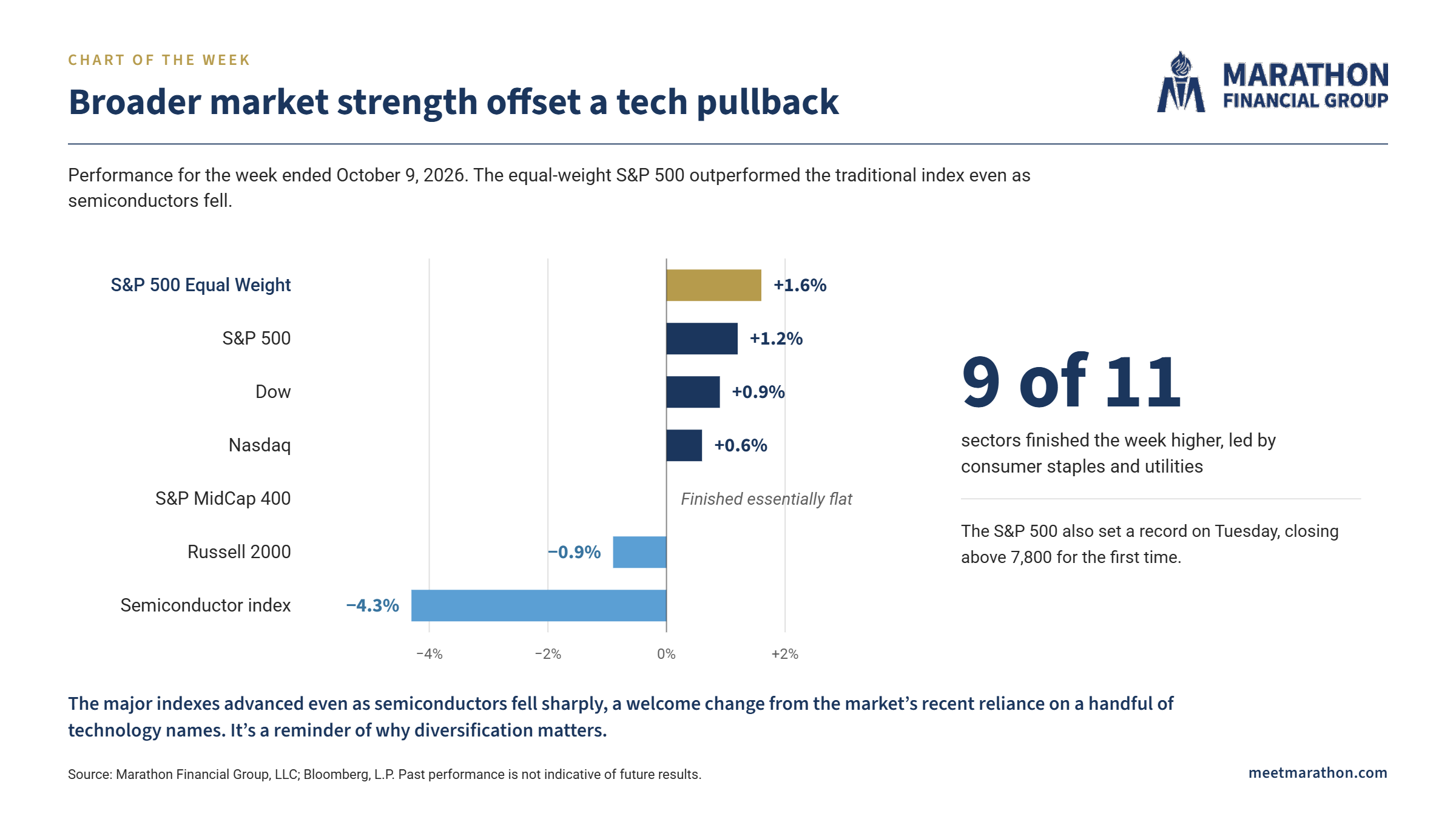
What made the week notable was the improvement in market breadth. The S&P 500 Equal-Weight Index gained 1.6%, outperforming the traditional index, and nine of the 11 sectors finished higher. Consumer staples and utilities led the way, while consumer discretionary, health care, financials, and energy also posted solid gains. The S&P 500 reached a new record high on Tuesday, closing above 7,800 for the first time.
That broader strength was encouraging after a stretch in which a relatively small group of large technology companies had been responsible for much of the market’s advance. It also helped cushion the impact of Thursday’s selloff in semiconductor stocks, when renewed questions about the pace of AI-related revenue growth triggered a sharp reversal across several industry leaders. The semiconductor index fell 4.3% for the week, despite starting on stronger footing.
Unlike their large-cap counterparts, small-cap stocks remained under pressure, and higher borrowing costs continued to weigh on areas such as housing. Still, the fact that the major indices advanced while semiconductors declined sharply was a welcome change from the market’s recent dependence on a handful of technology names.
The Economy
Economic data continued to point to an economy that is holding up, although consumers are showing signs of strain indicative of a still K-shaped economy. The ISM services index came in at 54.9, highlighting continued expansion, though it fell short of expectations. Prices paid by service businesses remained a concern, suggesting that inflation pressures have not fully disappeared. The August trade deficit also widened more than expected, driven in part by higher imports of crude oil and semiconductors.
The labor market remains relatively stable. Initial jobless claims fell to 197,000, continuing a pattern of low layoff activity. That is a positive sign for employment, although low layoffs alone do not guarantee that hiring will remain strong. Meanwhile, consumer credit increased by less than expected in August, with revolving credit declining, suggesting households may be becoming more cautious about taking on additional debt.
Consumer sentiment was a weaker point. The preliminary University of Michigan reading for October fell to 46.3 from September’s 48.1, reflecting continued frustration with the cost of living. That disconnect between a still-expanding economy and increasingly pessimistic consumers is worth watching. Households can continue spending even when confidence is weak, but persistent pressure from prices and borrowing costs could eventually affect demand.
Overall, the data do not point to an economy in immediate distress. However, with inflation still a concern and consumers feeling squeezed, the balance between economic resilience and the pressure of higher rates is something we recognize.
The Fed & Fixed Income
Treasury yields remained elevated throughout the week, with the 10-year yield briefly climbing to 5.36%, its highest level of the year, before strong demand at government bond auctions helped push it lower. By Friday, the 10-year yield stood at 5.24%, down four basis points for the week. The 2-year yield finished at 4.79%, down three basis points.
The retreat offered some relief to stocks, particularly rate-sensitive areas, but the broader interest-rate environment remains challenging. Yields have risen as markets weigh persistent inflation, the strength of the economy, government borrowing needs, and the possibility that the Federal Reserve may need to keep policy restrictive for longer.
The September Fed meeting minutes showed that most policymakers continued to see a high likelihood of another rate increase before year-end. That view is consistent with the Fed’s concern that inflation could remain above target even as the economy gradually cools.
For stocks, higher yields create pressure in two ways: they increase financing costs for businesses and make future earnings less valuable when measured against the return available from bonds and cash. This is particularly difficult for smaller companies and businesses that depend heavily on borrowing. It also raises the bar for more highly valued growth stocks, which need to deliver sufficient earnings and cash-flow growth to justify their valuations.
The week’s decline in yields was helpful, but one pullback does not necessarily signal a lasting change in direction. Until inflation shows more consistent improvement, interest rates are likely to remain an important influence on market leadership.
Company News & Earnings
The week offered a useful reminder that not all AI-related businesses are exposed to the same opportunities or risks.
On the positive side, Marvell raised its long-term revenue outlook, citing stronger demand for optical connectivity and switching products. AMD also pointed to strong demand for its AI products and plans to increase supply in 2027. Ciena, Corning, and Hewlett Packard Enterprise benefited from continued optimism around networking and AI infrastructure. These developments suggest that investment in AI is supporting a wider ecosystem of companies beyond the largest chipmakers.
However, Thursday’s semiconductor selloff showed how quickly sentiment can change when questions emerge about the spending that supports the AI trade. A report concerning OpenAI’s revenue trajectory raised doubts about the pace of growth underpinning the infrastructure buildout, sending semiconductor stocks lower. Subsequent reporting offered a more constructive picture of OpenAI’s revenue outlook, but it was not enough to produce a sustained rebound across chipmakers.
That reaction does not, by itself, mean the AI investment cycle is ending. It does show that expectations are high and that markets are increasingly sensitive to whether spending translates into revenue, profits, and ultimately cash flow. Companies tied to the AI ecosystem will need to demonstrate that demand is sustainable and that their investments can generate attractive returns.
Elsewhere, PepsiCo reported better-than-expected quarterly results but lowered its full-year earnings outlook, highlighting the challenge of managing growth and margins in a difficult consumer environment. Tesla shares benefited from reports of improving vehicle sales in China, while Palantir continued to advance on favorable analyst commentary.
The most important development may be the start of earnings season. Major banks will provide an early read on credit quality, lending activity, and the health of consumers and businesses. Taiwan Semiconductor will be particularly important for assessing demand across the semiconductor industry and whether spending on AI infrastructure continues to support the sector’s growth expectations.
Geopolitics
Developments involving the U.S.-Iran conflict and the Strait of Hormuz continued to drive sharp moves in crude oil. Prices fell early in the week as Middle Eastern export flows improved, then jumped Thursday following reports of renewed attacks on tankers. Oil subsequently retreated from its intraday highs after President Trump said the U.S. was engaged in productive discussions with Iran and would not launch additional strikes before the November elections.
WTI crude ultimately finished the week at $91.92 per barrel, up modestly from the prior week. Energy stocks benefited from the swings in oil, while the uncertainty continued to complicate the inflation outlook.
The key issue is whether higher energy prices become a sustained source of inflation pressure. A prolonged disruption to shipping through the Strait of Hormuz could push transportation and production costs higher, leaving the Fed with less room to ease policy. For now, developments remain fluid, and oil prices may continue to react sharply to headlines.
Week Ahead
The third-quarter earnings season begins in earnest, with major banks and other financial companies among the first to report. Their results should offer insight into loan demand, credit quality, trading activity, and the financial health of households and businesses. Several prominent health care companies will also report, providing a look at demand, pricing, and earnings trends in a sector that has shown relative resilience.
Taiwan Semiconductor will be one of the most closely watched reports. Its results and outlook should help investors assess whether demand for advanced chips and AI infrastructure remains strong enough to support the sector’s elevated growth expectations. The key will be whether management commentary confirms that investment is translating into durable demand, rather than simply reflecting spending concentrated among a small number of large customers.
Interest rates and oil prices will remain important variables as well. Treasury yields are still near their highest levels of the year, while developments in the Middle East could influence energy prices and inflation expectations.
For long-term investors, the coming week is an opportunity to look past the daily swings and focus on what company results reveal about earnings quality, balance sheets, and future cash-flow growth. The recent improvement in market breadth is encouraging, but a more durable advance will depend on solid fundamentals across a wider range of businesses, not just a handful of market leaders.
As always, please reach out to us for any questions and thank you for your trust.
Michael Neill, CFA
This communication is for informational purposes only and does not constitute an offer to sell or a solicitation of an offer to buy any securities. Any references to specific securities are not recommendations and should not be relied upon as investment advice.
Data Sources: Marathon Financial Group, TradingEconomics & Bloomberg, LP.