


Key Takeaways
- Market gains remained concentrated. The major large-cap averages edged higher, while small- and mid-cap stocks declined, underscoring how much of the market's strength remains concentrated in larger companies.
- Mega-cap growth and software led the way. Strong results from NVIDIA, Salesforce, and CrowdStrike reinforced demand for AI, cloud computing, and cybersecurity. At the same time, the broader semiconductor group lagged.
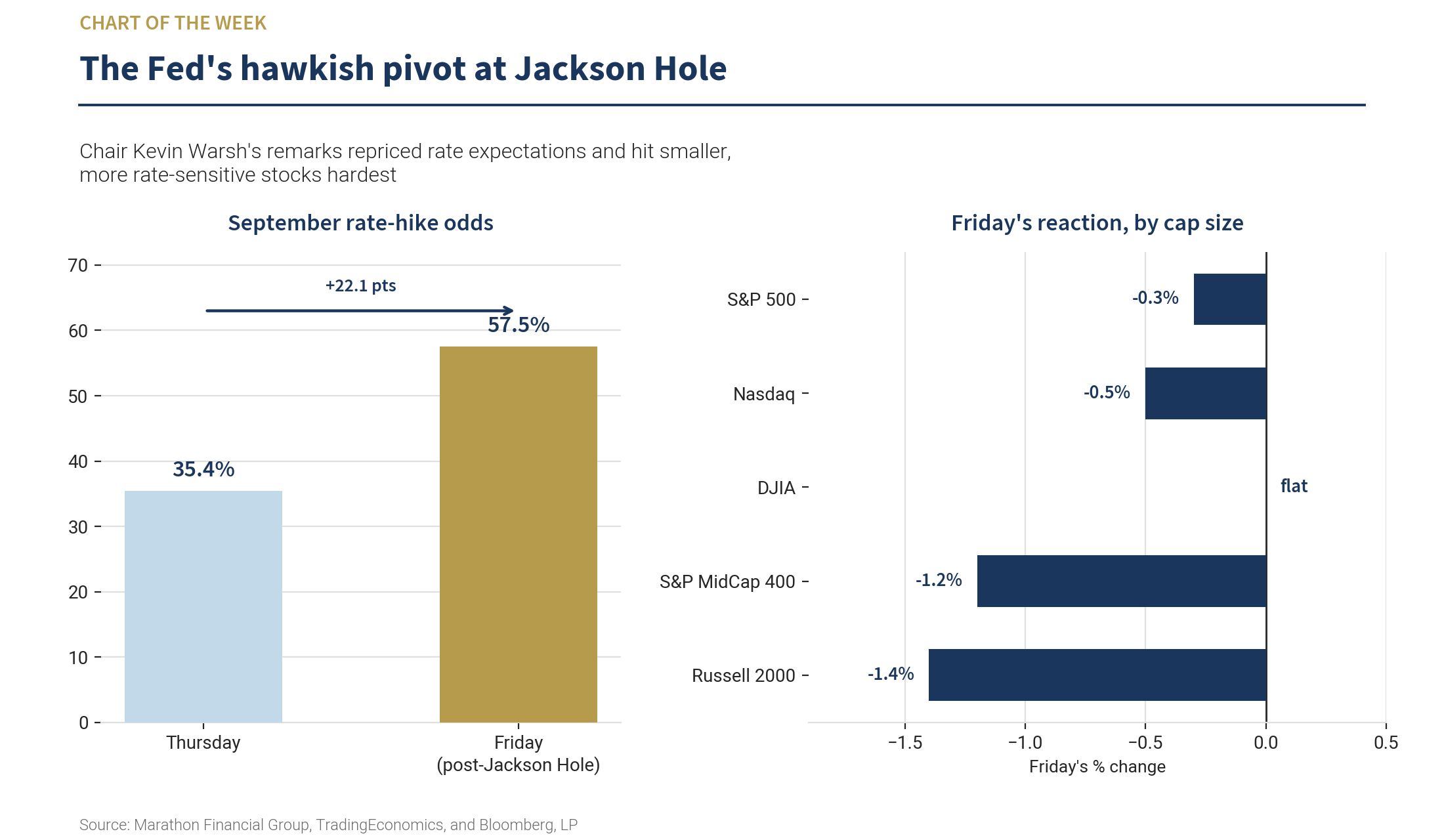
- The Fed's tone shifted more hawkish. Chair Kevin Warsh's Jackson Hole remarks pushed Treasury yields higher and increased expectations for a September rate hike. Smaller, more rate-sensitive companies felt the pressure.
- The economy continues to grow, although consumers remain cautious. Growth and business investment data were generally solid, while consumer sentiment remained depressed amid ongoing inflation concerns.
- Investors are becoming more selective. Strong earnings alone are not enough. Companies with durable growth, healthy fundamentals, and a clearer path to future earnings are receiving more support than those where valuations have gotten ahead of the underlying business.
Market Summary
U.S. equities finished the week modestly higher, although the gains were concentrated in a relatively small group of large-cap growth and software companies. Small- and mid-cap stocks struggled, highlighting the continued divergence between the largest companies and the broader market.
Large-cap growth remained the strongest area of the market. Information technology gained 1.8%, while communication services and financials also finished higher.
Health care, energy, industrials, and real estate were the primary laggards. Small- and mid-cap stocks also underperformed as the week progressed, particularly after Friday's jump in short-term rates following Fed Chair Warsh's hawkish Jackson Hole speech.
The divergence within technology was particularly notable. NVIDIA surged following its earnings report, while the broader semiconductor index declined 2.3% for the week. We continue to see strong demand for AI, but the market is becoming less willing to reward companies simply for being part of the theme. Fundamentals matter more.
This reinforces why we continue to emphasize companies with industry leadership, reliable management teams, healthy balance sheets, strong cash generation, and durable earnings growth. We believe those characteristics become particularly important when market leadership narrows and valuations are elevated.
Economy
The U.S. economy continues to expand at a moderate pace. Second-quarter GDP growth held at an annualized 1.5%, while a stronger measure of domestic demand – real final sales to private domestic purchasers – was revised higher to 4.2%. That suggests consumers and businesses are still providing a solid foundation for economic activity.
Business investment also remains healthy. Durable goods orders excluding transportation were up 14.3% from a year earlier, while weekly jobless claims remained near historically low levels. Hiring remains relatively stable, and businesses continue to invest.
The softer part of the economy is the consumer outlook. University of Michigan sentiment remained depressed, with households continuing to point to inflation as a major concern.
Overall, growth remains steady, but there are few signs of acceleration. This is one reason we continue to favor high-quality companies that can grow through a range of economic environments. A resilient economy is helpful, but we do not believe investors should rely on economic growth alone to drive returns.
Fed, Fixed Income & Rates
Federal Reserve Chair Kevin Warsh's address at the Jackson Hole Symposium shifted the interest-rate conversation. He emphasized that inflation remains above the Fed's target and that restoring price stability remains the central bank's predominant focus.
Markets responded quickly, meaningfully increasing the odds of a rate hike at the Fed's September meeting. Treasury yields moved higher, with the largest increase at the short end of the curve. Yields on several shorter maturities reached fresh highs for the year. Treasury auctions were generally well received during the week, although demand softened modestly in the middle of the curve.
Higher short-term rates were particularly challenging for smaller companies, which tend to rely more heavily on external financing. Larger companies with stronger balance sheets and more robust cash generation are generally better positioned to absorb a higher-rate environment.
This is another area where we believe balance-sheet strength and free cash flow matter. Companies that can fund growth internally have more flexibility when the cost of capital rises, while highly leveraged businesses can become increasingly constrained.
Treasury yields (Friday close):
- 2-year: 4.35% (+12 bps on the week)
- 10-year: 4.72% (-2 bps on the week)
Company News & Earnings
Corporate earnings continued to provide encouraging signals, particularly across technology and enterprise software.
NVIDIA delivered another strong quarter, sending shares sharply higher initially as investors responded to continued demand for AI computing. The stock gained 8.7% on Thursday before giving back some of that advance the following day. The reaction highlights both the strength of NVIDIA's underlying business and the very high expectations already reflected in the stock.
Salesforce was another standout. Shares jumped 22.6% after the company reported strong results and provided evidence of improving demand. CrowdStrike also gained more than 20%, reinforcing the continued strength of spending on cybersecurity and cloud-based software.
Outside technology, Abercrombie & Fitch jumped 35.6% after reporting strong sales and improving its outlook, while Workday also moved higher following its results. On the other hand, Best Buy and Burlington Stores declined after disappointing reports, another indication that consumers remain selective when it comes to discretionary spending.
This earnings season continues to reinforce a simple point: beating expectations matters, but investors ultimately care about what comes next. We want to see companies that can translate strong demand into sustained earnings and cash-flow growth rather than simply deliver one strong quarter.
That distinction is increasingly important as valuations remain elevated in portions of the market. In our view, growth is most attractive when it is supported by real earnings, improving free cash flow, and a management team with a track record of executing against its strategy.
Geopolitics
Oil markets remained sensitive to developments involving Iran and the Strait of Hormuz. Crude prices swung with each new headline before ultimately settling notably lower for the week.
Early in the week, the U.S. Treasury launched a new economic pressure campaign targeting Iran-linked entities, brokerage networks, and other critical sectors. Mid-week, oil briefly spiked on reports of a potential Iran-Oman arrangement involving Strait of Hormuz traffic. An Iranian official disputed that the strait was actually reopening, and crude ultimately settled little changed. Late in the week, oil reversed higher again on reports that the White House does not intend to revive an earlier understanding with Iran.
The decline in crude for the week provided some relief for consumers and businesses, particularly after concerns earlier in the summer that a prolonged disruption could create another inflationary shock. The situation remains fluid, however, and a renewed escalation could push energy prices higher quickly.
The headlines matter less than potential economic consequences. The key question is whether a disruption is significant and persistent enough to affect inflation, consumer spending, or corporate profitability.
Week Ahead
The coming week will give investors two important things to watch: the health of the labor market and whether the strong growth in AI-related earnings is continuing.
Employment data takes center stage. Investors will receive JOLTS job openings, ADP private payrolls, and Friday's August employment report. The jobs report is particularly important given the Fed's more hawkish tone. A strong reading could reinforce expectations for higher rates, while continued cooling in the labor market would give policymakers more flexibility. Current expectations call for roughly 58,000 new jobs and a 4.1% unemployment rate.
Broadcom reports Wednesday and will be one of the week's most important earnings releases. Following NVIDIA's strong results and outlook, investors will be looking for evidence that demand for AI networking and custom chips remains robust, as well as similar visibility into future AI-related growth.
Palo Alto Networks reports Tuesday, providing another important read on enterprise cybersecurity spending. Investors will be watching growth, margins, and the impact of its CyberArk acquisition, particularly after the stock's significant run this year and elevated expectations heading into the report.
The key question heading into next week is whether strong corporate earnings can continue to offset higher interest rates. A resilient labor market and continued AI investment would support the market. Weaker employment data or disappointing technology guidance could lead to greater volatility.
As always, please reach out to us for any questions and thank you for your trust.
Michael Neill, CFA
This communication is for informational purposes only and does not constitute an offer to sell or a solicitation of an offer to buy any securities. Any references to specific securities are not recommendations and should not be relied upon as investment advice.
Data Sources: Marathon Financial Group, TradingEconomics, Bloomberg, LP.
Chart Source: Marathon Financial Group, CME Fed Watch Tool