


Hello Marathoners-
I hope your 2026 is off to a good start. While this isn’t the best time of year here in the Northeast, virtually half of my family (me included) has a birthday in this final week of January, so the joint celebration is a highlight we look forward to.
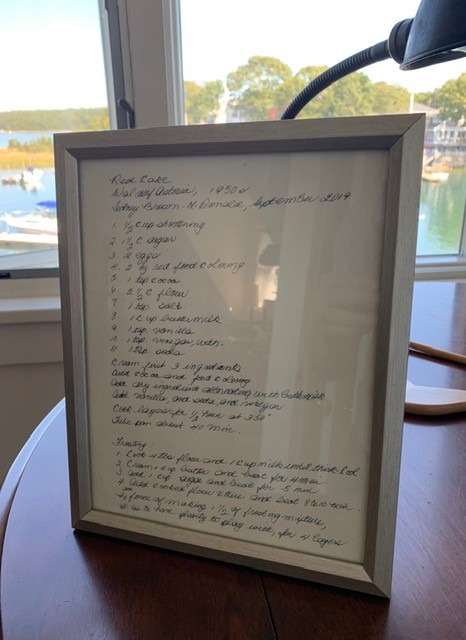
My favorite perennial tradition for the January birthday crew is the Waldorf Astoria Red Velvet Cake, which my grandmother Sidney has been perfecting since the 1950s. While most call it ‘Red Velvet Cake’, in the Brown family we simply say ‘Red Cake’, because it is the Brown family cake, and we steadfastly believe that all other recipes for Red Velvet Cake are a travesty. What snobs!
The Waldorf Astoria Red Velvet Cake is characterized by a mild cocoa flavor, a slight tang from the buttermilk and vinegar, and is famously paired with boiled milk frosting, rather than the cream cheese frosting more common today.
While it’s Sidney’s birthday this week as well, she almost never delegates the baking of the sacred Red Cake. Here’s a picture of Sidney going back to her surprise 80th birthday, which captures her blowing out the candles on a Red Cake made by another family member (and by the look on her face, I think simultaneously judging it!)

The Red Cake tradition is so special to me, and so indelibly linked to Sidney, that I asked her to hand-write the recipe as a keepsake. And also just because her handwriting is one-of-a-kind!
First, I’ll just quickly share links to updated guides breaking down important numbers and dates for 2026, and some things to think about at the start of the year.
What Issues Should I Consider At The Start Of The Year
Howard Marks, who is nearly 80, is the co-founder and co-chairman of Oaktree Capital Management, the world’s leading investor in distressed securities.
Like all outstandingly successful investors, Mr. Marks is first and foremost a student of human nature. And among his many astute observations is this gem:
“Security prices fluctuate much more than do the intrinsic values and prospects of the underlying companies, and the main reason for this is extreme volatility in the way people feel about risk.”
This is profound to me because it speaks directly to investors’ most common misperception of risk. They mistake emotion-driven declines in stock prices for permanent impairment in the enduring values of the companies.
Then, as stock prices crater in the late stages of a bear market, investors lose the ability to distinguish between temporary declines in those prices and permanent loss in the value of the companies. And when that happens—crying out the four classic words ‘This time is different’—they flee into cash.
Of such capitulation—massive panics feeding on themselves, irrespective of fundamental values—all the great market bottoms have been made.
Investment advisors try to point out to their fear-stricken clients that the greatest long-term advances in stock prices have historically been born out of just such climactic panics. One need look no further than the Global Financial Crisis: a 17-month, 57% decline in the S&P 500, which bottomed on March 9, 2009. It was by far the largest price decline in mainstream equities since the period 1929-32.
Yet out of the ashes has come one of the longest and strongest uptrends in stock prices of all time—an advance which is still ongoing. If you were a long-term holder of the S&P 500 in March 2009, even with dividend reinvestment your account value was about half what it had been at the October 2007 peak. But $100,000 left to compound in March 2009 (taxes paid from another source) was recently worth more than $1.1 Million—having grown in the interim at an average rate of 16% per year.
And to persevere in March 2009, all you really had to do was strenuously doubt that the enduring value of the companies—in this example, 500 of the strongest, best managed, most innovative companies of all time—had suffered a permanent impairment of anything remotely approaching 57%.
An even more dramatic demonstration of the bifurcation of stock prices and intrinsic values is offered by the 33-day, 34% decline in the S&P 500 when the firestorm of COVID enveloped the world. Granting that the global economy was shutting down and earnings visibility had essentially vanished, it was still more than possible to ask, “Do I think the enduring values of these companies have in the space of a month lost one out of every three dollars?” And of course—urged on by their financial advisor—almost anyone might easily have said, “That just doesn’t seem probable.” A mere five months later, the Index was back to its previous peak. It’s three times higher than that now.
Thus, it would seem that, in crisis, the shortest, straightest path to rationality may be Mr. Marks’ quietly devastating assessment that the ongoing values of companies and their stock prices are subject to very significant discrepancies, once investor sentiment reaches a crowded consensus.
When talking to fearful investors, Nick Murray simply asks the question:
“Does your garden die in the winter?”
Nick says “Like all analogies this one is far from perfect, but my experience is that at the very least it abruptly redirects the conversation—away from the unknowable resolution of the crisis du jour, and toward an intuitive sense of the enduring value of the companies one owns for the long-term.”
For in fact, perennials don’t die, even in harsh, prolonged winters. During the growing season, they store energy in their roots, bulbs, and elsewhere. That energy allows plants to go dormant in the winter; they begin growing and blooming again when temperatures moderate. Or think of trees, losing all their leaves each fall and growing new ones the next spring.
Successful businesses tend to function similarly. When economic and financial adversity strikes, their earnings will suffer—at times significantly—while their highly compensated management teams move to shore up capital, reduce headcount, sell or shutter losing business lines, acquire assets strategically from ailing competitors—and above all, continue innovating.
Indeed, your garden doesn't die in the winter. And a broadly diversified portfolio of America's most successful companies has survived—and gone on to thrive—in the bleakest economic/financial winters. Past performance may not guarantee future results—and it surely doesn't—but history is, at the very least, highly suggestive in this regard.
Have a great weekend.
-Charlie